Why Do We Need An Intercooler? What Are The Consequences Of High Intake Temperature?
The core task of the intercooler is to "cool and reduce the temperature" of the high-temperature air after turbocharging, because excessively high intake temperature is the "number one killer" of engine performance, efficiency, and lifespan.
If the intake air is not cooled down and high-temperature air is directly allowed to enter the cylinder, it will cause the following three serious consequences:
Detonation (the 'fatal internal injury' of the engine)
This is the most dangerous and direct consequence.
Principle: High temperature air entering the cylinder will cause a sharp increase in the temperature of the mixture (air+fuel) inside the cylinder. Before the spark plug ignites, the mixture may spontaneously ignite (self ignite) due to high temperature and pressure, resulting in irregular combustion.
Consequence: This will cause strong detonation, produce knocking sounds, and bring huge impact pressure to components such as pistons and connecting rods. In severe cases, the piston can break through or burn the spark plug within a few seconds, directly causing the engine to be scrapped.
Severe power reduction (oxygen content becomes diluted)
The original intention of turbocharging is to "increase air", but if the air becomes hot, the effect will be greatly reduced.
Principle: The power of the engine depends on how much fuel is burned, and the complete combustion of fuel depends on the oxygen content of the air. The movement of hot air molecules is intense, resulting in a decrease in density (like a balloon that expands and contracts), and the number of oxygen molecules per unit volume is much less than that of cold air.
Consequence: The air becomes hot and thin, which means there is insufficient oxygen. The engine computer (ECU) will forcibly delay the ignition advance angle and reduce the fuel injection quantity to prevent detonation. The result is that although the turbine increases pressure, the actual power actually decreases, even inferior to naturally aspirated engines of the same displacement.
Excessive emissions and shortened turbine lifespan
Deterioration of emissions: High temperature air leads to insufficient combustion, which produces more nitrogen oxides (NOx, a harmful gas) and black smoke, making it difficult to meet environmental testing standards.
Increased burden on the turbocharger: The intake temperature itself is a byproduct of the compressed air produced by the turbocharger. If heat accumulates at the turbine end (exhaust side), it will accelerate the wear of the turbine bearings and shorten the service life of the engine oil (lubricating oil). High temperatures can even cause the engine oil to coke (thicken, harden).
How is the intercooler solved?
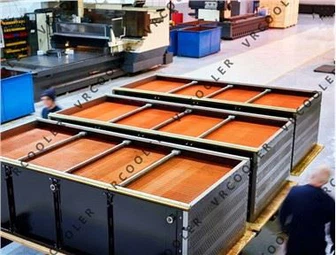
The intercooler is installed between the turbocharger and the engine intake manifold. Its function is to act as a 'heat sink':
When the air from the turbine (with a high temperature of about 150 ℃~200 ℃) flows through the pipes inside the intercooler, the high-speed airflow or fan outside will take away the heat and cool it to around 50 ℃~60 ℃.
After cooling, the air density significantly increases, the oxygen content increases, and the combustion is more complete, which not only restores power but also eliminates the risk of detonation.