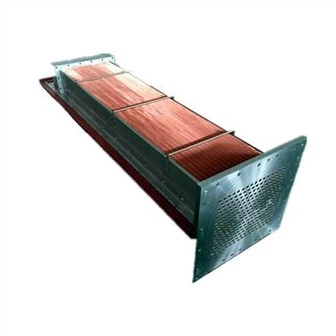
Why Do Generators Need To Use Remote Radiators?
Remote Radiator refers to a cooling system layout in which the core components of the radiator are separated from the engine block in a generator set and installed remotely (such as outdoors, on a rooftop, or in an adjacent room) through a circulation pipeline.
In specific scenarios, using a remote heatsink is necessary, and even the only solution. The core reasons can be summarized into four points:
Free up installation space and solve heat dissipation problems: This is the most common application scenario. When the generator set must be installed in a basement, enclosed computer room, or extremely narrow space, there is simply not enough ventilation to take away the hot air discharged by the standard radiator. The remote radiator can move the heating components outdoors, perfectly solving the heat dissipation and ventilation problems in the computer room.
Significantly reduce the noise in the computer room: The standard radiator is directly driven by the engine to generate a fan, resulting in loud noise. The remote radiator adopts an electric fan and migrates the main noise sources (fan and radiator body) to a distance, making the generator room very quiet, which is crucial for noise sensitive areas such as hospitals, data centers, hotels, etc.
Improve heat dissipation efficiency and avoid hot air backflow: The hot air discharged by standard radiators in the computer room is easily sucked in again by the fan, forming a "hot air backflow" that leads to a linear decrease in cooling efficiency. The remote radiator is installed in an open outdoor area, which can directly suck in fresh cold air, completely avoiding the problem of hot air backflow, and the heat dissipation effect is more stable and efficient.
Provide economic solutions for high-power units: For high-power generators above 500kW, there are huge requirements for the size and exhaust volume of the radiator. In this case, adopting a remote radiator solution would actually be more cost-effective than retrofitting ventilation and installing complex air ducts in the computer room.
Remote radiator systems are more complex than standard radiators, and special attention should be paid during design to:
Core components: The system typically consists of an engine, heat exchanger (or directly connected), remote radiator, circulating water pump, electric fan, and expansion tank. The intelligent controller will automatically control the start stop and speed of the water pump and fan based on the engine water temperature to save energy.
Pipeline design: The pipeline connecting the engine and remote radiator needs to consider the resistance and height difference along the way. To prevent water pump cavitation (suction), it is necessary to carefully calculate the flow rate and pressure, and ensure that the coolant flow rate in the pipeline does not exceed 2 m/s to protect the pipeline.
The expansion tank is crucial: the expansion tank (also known as the high-level water tank) must be installed at the highest point of the entire cooling system. Its function is to accommodate the volume of coolant that expands due to heat, discharge air from the system, and provide stable suction pressure for the water pump.
Environmental adaptability: In cold regions, outdoor pipelines and radiators require electrical tracing and insulation measures to prevent coolant freezing.