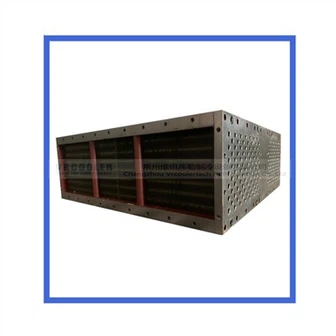
Custom Finned Tube Heat Exchanger For Air Compressor Waste Heat Utilization
In many factories, the air compressor runs for hours every day, quietly doing its job in the corner of the plant. It supplies compressed air for valves, tools, packaging lines, and production equipment, but it also throws away a surprising amount of energy in the form of heat. That is why compressor heat recovery has started to get more attention. Atlas Copco notes that more than 90% of the electrical energy used by a compressor is converted into compression heat, while Kaeser states that essentially 100% of the electrical energy going into an industrial air compressor ends up as heat somewhere in the system, with a very large share of that heat recoverable for useful purposes.
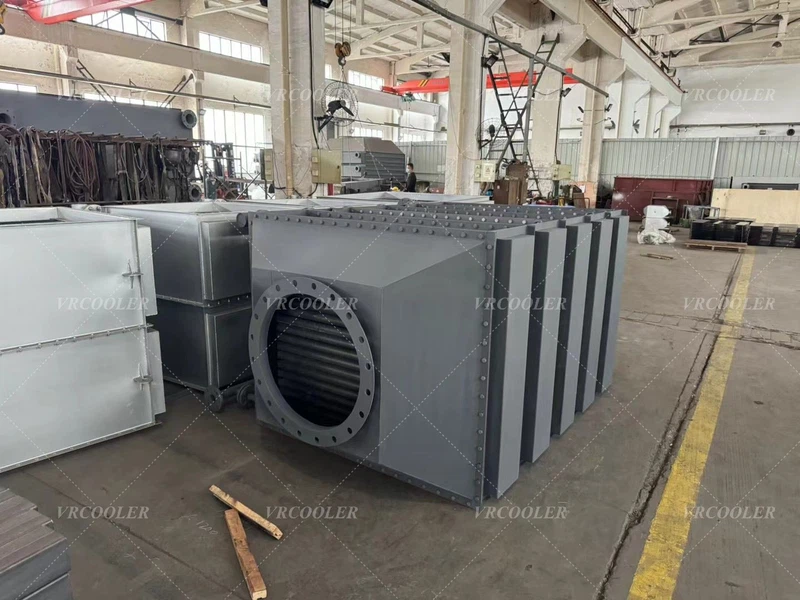
This is where a finned tube heat exchanger becomes a very practical solution. The idea is simple: instead of letting compressor heat disappear into the atmosphere, the system transfers that heat to another air stream or fluid stream that can actually be used in the plant. A finned tube design works especially well when air is one of the media, because the fins increase the heat transfer surface and help move heat more effectively between the tube-side fluid and the surrounding air. The U.S. Department of Energy's steam and process-heating references specifically note that finned tube heat exchangers are commonly used for heating air in drying and space-heating applications, which is exactly why they fit so naturally into compressor heat recovery projects.
In real industrial use, the heat from an air compressor can be recovered in two common ways. The first is to capture the warm exhaust air from an air-cooled compressor and direct it to another area that needs heat. Kaeser describes this as a straightforward method for space heating, using ductwork and controls to send the warmed air to workshops, warehouses, or nearby rooms. The second method is to recover heat into a water or process-fluid loop, then pass that hot fluid through a heat exchanger for another useful purpose. Atlas Copco explains that water-cooled compressor systems can recover heat into hot water circuits, and Kaeser notes that fluid heating from compressors can be used for applications such as boiler makeup water, process-fluid heating, food and beverage processes, and hot water service.
For many plants, a finned tube heat exchanger is attractive because it turns that recovered energy into something immediately useful: heated air. For example, a factory may recover heat from the compressor oil cooler or cooling-water loop, send that hot fluid through a finned tube coil, and use a fan to blow ambient air across the fins. The result is warm air that can be supplied to a workshop, a drying room, a fresh-air make-up unit, or a production area during colder months. That makes the system feel less like an energy-efficiency add-on and more like a piece of working plant equipment that offsets other heating demand every day the compressor is running. DOE guidance on compressor systems says compressor waste heat can be used effectively for space heating and process-water heating, often with attractive payback because the heat is already being produced anyway.
What makes the finned tube style especially suitable is the nature of air itself. Air is a relatively poor heat-transfer medium compared with water, so bare tubes alone are often not enough if you want a compact, effective coil. By adding fins, the exchanger gains much more contact area on the air side, which improves performance without making the unit excessively large. That is why finned tube coils are so widely used in air heaters, duct heaters, make-up air units, and drying equipment. In a compressor heat recovery system, this same principle helps convert low-cost waste heat into a stable and usable stream of warm process air.
A good compressor heat recovery design is not only about the heat exchanger itself. The whole system has to be matched properly. Kaeser emphasizes the importance of a thermal match between the heat available from the compressor and the heat actually needed by the process. That point matters more than many people realize. If the compressor runs only intermittently, but the heating demand is continuous, the recovered heat may not be enough on its own. If the available water temperature is too low, the air leaving the finned tube coil may not be warm enough for the application. And if the coil is selected only by guesswork, the result may be a large pressure drop, weak airflow, or disappointing outlet temperature. A well-designed system has to balance compressor operating hours, available heat, fluid temperature, airflow, and target air-off conditions.
Another reason these systems deserve attention is the scale of the savings. Atlas Copco says that up to 94% of compression heat can be recovered, and Kaeser says up to 96% of the heat can be put to use under the right conditions. Those are not promises for every installation, but they show why heat recovery from compressors is often one of the more practical energy projects in a factory. Instead of burning new fuel or adding electric heaters for every heating duty, the plant can reuse heat it has already paid for once through compressor power consumption.
From a plant-operator point of view, that is really the strongest argument for a finned tube heat exchanger in this type of system. It is not glamorous equipment. It does not usually get the spotlight. But it helps turn a compressor from a pure power consumer into a partial energy source. It can reduce heating cost, improve overall system efficiency, and make better use of equipment that is already running every day. In many cases, the smartest heat in a factory is not new heat at all. It is the heat that was already there, waiting to be recovered and used properly.