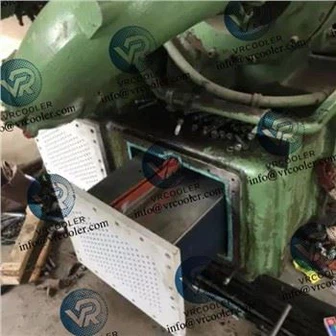
Power Plant Air, Hydrogen And Water Generator Cooler
Power plant equipment mainly faces the following problems in summer: vacuum drop of steam turbine, rise of oil temperature of oil cooler, rise of oil temperature of transformer, rise of temperature of generator rotor and stator, etc. These problems are all temperature related.
During the operation of the generator, the losses of copper and iron are converted into heat energy, which makes all parts of the generator heat up. In order to ensure that the winding insulation material of the generator can run for a long time at the allowable temperature, the heat generated by the copper loss and iron loss must be removed. Therefore, the generator must be continuously cooled. The quality of the cooling effect of the generator has a great influence on the capacity of the generator. Therefore, the output of the generator is also different depending on the cooling medium.
There are generally three kinds of cooling media for generators: air, hydrogen and water. Small and medium-sized generator sets generally use air coolers to cool generators. The so-called air cooler, as the name implies, is an air heat exchanger cooler, the air removes the heat generated by the generator, and the air is cooled by water to reduce its temperature. The heat exchange equipment is the air cooler. Its structure is simple. The main component is a copper tube radiator. The water goes inside the tube and the air goes outside the tube.
The cooling air mainly relies on water. The water flowing in the tube exchanges heat with the air outside the tube. In addition to the water temperature, the effect of heat exchange is also very important. In small and medium-sized power plants, the water of the air cooler generally adopts an open cycle, and the water is adjusted by adding anti-scaling agents, bactericides, etc. to adjust the water quality.