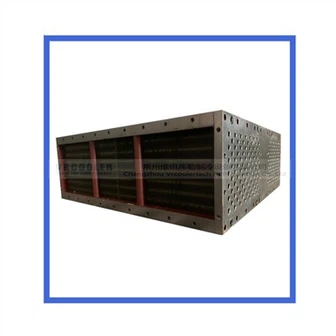
Hydrogen Cooler For Generators in Thermal Power Units
Hydrogen Cooler for Generators in Thermal Power Units
Hydrogen Cooler for Thermal Power Plant Generator
Thermal power plant generators typically utilize hydrogen as a cooling medium (hydrogen's thermal conductivity exceeds that of air by over 7 times, and its low density and minimal air resistance loss significantly enhance generator heat dissipation efficiency and power generation efficiency). The core function of the hydrogen cooler is to reduce the temperature of "high-temperature hydrogen after heat absorption." Its operating principle is based on shell-and-tube heat exchange, with the specific process as follows:
Hydrogen-Side Circulation: High-temperature hydrogen gas (typically 40-60°C) generated by internal losses within the generator is forced to flow through the "shell side" (or gas-side passages) of the hydrogen cooler. As it passes over the outer surface of the heat exchange tube bundle, it transfers heat to the tube bundle walls.
Heat Conduction: The tube walls (usually copper or copper alloys with excellent thermal conductivity) conduct the absorbed heat from the hydrogen side to the cooling medium inside the tubes.
Coolant Side Circulation: Low-temperature coolant (often thermal power plant circulating water or closed-loop cooling water at 20-35°C) flows rapidly through the "tube side." It removes heat from the tube bundle walls via convective heat exchange. After its temperature rises (typically by 5-10°C), the coolant exits the cooler and is ultimately cooled via equipment like cooling towers before being recycled.
Hydrogen Cooling: After releasing heat, the hydrogen temperature drops to 30-40°C. It is then reintroduced into the generator to absorb heat again, forming a closed-loop cooling cycle of "heat absorption - cooling - reabsorption."