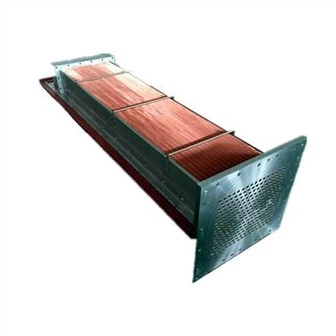
How To Know If Your Generator Hydrogen Cooler Needs Maintenance?
How To Know If Your Generator Hydrogen Cooler Needs Maintenance?
How To Know If Your Generator Hydrogen Cooler Needs Maintenance?
Determine the need for maintenance by operating parameters
1. Abnormal hydrogen temperature
Monitoring indicators:
Inlet hydrogen temperature of the generator (normally should be maintained at the design value, e.g. 40 ± 2 ℃);
Difference between outlet hydrogen temperature and inlet temperature (the temperature difference reflects the heat exchange efficiency of the cooler, usually 8~12℃).
Abnormal performance:
If the outlet hydrogen temperature continues to rise and the inlet temperature does not change significantly, it is possible that the heat exchange capacity of the cooler has decreased (e.g., fouling of cooling tubes, blockage or insufficient coolant flow).
If the temperature difference is reduced (e.g. <5℃), the heat exchange efficiency may be reduced due to high coolant temperature, insufficient flow rate or air accumulation in the cooling tube.
Maintenance Recommendations:
Check whether the coolant (water) temperature, pressure and flow rate are normal, clean the cooling pipe or troubleshoot the coolant circulation system.
2. Abnormal coolant (water) parameters
Monitoring indicators:
Coolant inlet temperature (usually ≤ 33 ℃), outlet temperature (and inlet temperature difference is generally 6 ~ 10 ℃);
Coolant pressure (stable pressure during normal operation, such as 0.2~0.3MPa);
Coolant flow rate (within the design value, such as no significant changes).
Abnormal performance:
The coolant outlet temperature increases and the temperature difference increases, which may be due to the accumulation of scale on the hydrogen side outside the cooling pipe or internal blockage of the cooler.
Decrease in coolant pressure or flow rate, may be coolant system leakage, filter clogging or circulating pump failure.
Elevated coolant conductivity (e.g. > 5 μS/cm) may indicate a leak in the cooling tube (hydrogen or oil leaking into the water).
Maintenance recommendations:
Clean the cooling tube, replace the filter element, check the circulating pump and line sealing, and troubleshoot leaks.
3. Abnormal hydrogen purity and pressure
Monitoring indicators:
Hydrogen purity (normal ≥ 98%, oxygen content <2%);
Hydrogen pressure in the generator (maintained at the design value, such as 0.4MPa).
Abnormal performance:
Hydrogen purity decreases and is accompanied by an increase in the hydrogen content in the coolant, possibly due to a rupture of the cooling tube leading to hydrogen leakage into the coolant system.
Abnormal fluctuations in hydrogen pressure may be related to a seal failure of the cooler or a malfunction of the gas displacement system.
Maintenance Recommendation:
Pressure test the cooler (e.g., water or air pressure leak check) and repair or replace leaking cooling tubes.

Determining Maintenance Needs through Equipment Condition Inspection
1. Appearance and sound inspection
Inspection content:
Whether there are traces of oil, water or hydrogen leakage (e.g., condensation, oil stains, vapor-water mixtures) in the cooler body and piping connections;
Whether there is any abnormal vibration or noise (such as bearing wear, impeller jamming) in the coolant circulation pump, fan and other rotating parts.
Abnormal performance:
Liquid leakage from the casing or interface is a direct indication of seal failure or broken piping;
Vibration values exceeding the permissible range (e.g., pump body vibration speed > 4.5mm / s), may indicate mechanical failure.
Maintenance recommendations:
Tighten seals, replace broken lines, lubricate or overhaul rotating parts.
2. Internal inspection of the cooler (when shutting down for maintenance)
Inspection content:
Whether the inner surface of cooling tube is clogged with scale, sludge or debris (affecting heat exchange efficiency);
Whether there is oil sludge, metal debris or insulating paint deposition on the outer surface of the cooling tube (hydrogen side) (caused by internal wear and tear of the generator or aging of the insulation);
Whether there are cracks, corrosion or de-welding at the connection between the tube plate and the cooling tube (causing leakage).
Abnormal performance:
When the blockage rate of cooling pipe is >10% or the thickness of scale accumulation is >1mm, the heat exchange efficiency is significantly reduced;
Visible cracks or corrosion perforations in the weld seam of the tube plate.
Maintenance recommendations:
Chemical cleaning or mechanical unclogging of cooling tubes, grinding or patch welding to repair defects in the tube sheet, and replacement of the cooling tube set if necessary.

Determining Maintenance Requirements by System Abnormalities
1. Abnormal generator operation
Associated phenomena:
Stator winding, rotor winding or core temperature exceeds the limit (e.g. stator temperature > 110°C), which may be caused by insufficient hydrogen cooling;
Generator output decreases or forced to run at reduced load, possibly related to reduced efficiency of the cooling system.
Maintenance Recommendation:
Prioritize the exhaustion of the heat exchange capacity of the cooler, combined with the parameter monitoring results to determine whether cleaning or overhaul is required.
2. coolant system failure
Associated phenomenon:
Abnormal drop in coolant storage tank level may indicate system leakage;
Coolant circulating pump current fluctuation or exceeding the standard, may be due to pump body wear, impeller clogging or cavitation caused.
Maintenance recommendations:
Find leaks and repair, clean the pump body or replace damaged parts.