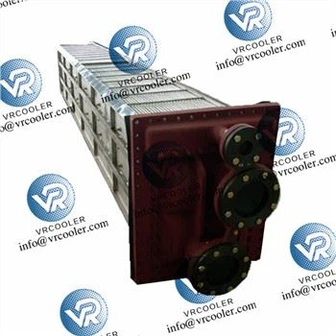
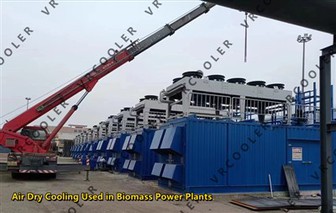
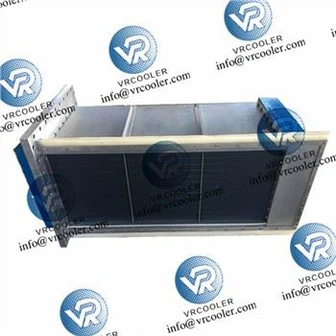
Generator Cooler Ensures Efficient And Stable Operation Of The Unit
1, The root cause of generator heating and the necessity of cooling
The heat generated during the operation of the generator mainly comes from three types of losses, among which copper loss and iron loss are the main heat sources, and mechanical loss accounts for a relatively small proportion. Together, they form the thermal load foundation that the cooling system needs to cope with.
Copper loss is the main heat source, accounting for more than 50% of the total loss. It refers to the Joule heat generated by the conductor resistance when the current passes through the stator and rotor winding conductors of the generator. The power loss is proportional to the square of the current and the conductor resistance. When the load increases, copper loss will significantly increase. This kind of heat not only reduces power generation efficiency, but also directly leads to an increase in winding temperature, damages insulation materials, and affects equipment life.
Iron loss is the second largest heat source, occurring in the stator and rotor cores. It is the energy loss generated by the cores under the action of alternating magnetic fields, mainly including eddy current loss and hysteresis loss. Eddy current loss is the heat generated by the annular current induced when an alternating magnetic field passes through the iron core. To reduce this type of loss, the generator iron core is usually made of insulated thin silicon steel sheets stacked together; Hysteresis loss refers to the heat generated by the conversion of energy consumed by internal intermolecular forces when the direction of magnetic domains in ferromagnetic materials changes with an alternating magnetic field. Choosing materials with high permeability and low coercivity can effectively reduce losses.
Mechanical losses mainly come from the friction and wind resistance of internal moving parts, including bearing friction, contact friction between the journal and the bearing shell, and wind losses caused by the high-speed rotation of the rotor and surrounding gases. Although the proportion is not large, long-term accumulation can also exacerbate equipment heating.
The harm of high temperature to generators is extremely significant: for every 8-10 ℃ increase, the service life of insulation materials will be shortened by half; When the temperature exceeds the critical point, it can cause rapid aging, cracking, and carbonization of insulation materials, leading to short circuit faults; At the same time, an increase in temperature will increase the resistance of the conductor, further exacerbating energy loss and forming a vicious cycle of "temperature rise loss increase further temperature rise". Therefore, an efficient and reliable cooling system is the key to maximizing the performance and extending the service life of a generator. Studies have shown that for every 10 ℃ decrease in operating temperature, the expected service life of the generator can be doubled, while also improving power generation efficiency and preventing over 95% of thermal related failures.

2, Main types and characteristics of generator coolers
With the continuous development of power generation technology, generator coolers have formed various technical routes to meet the needs of different power and scenarios of generator sets. Among them, air cooling, water cooling, and hydrogen cooling are the three mainstream types. In recent years, new composite technologies such as evaporative cooling and phase change cooling have also accelerated their penetration, showing a diversified development trend.
(1) Air cooler: an economical and convenient basic choice
Air coolers use air as the cooling medium to remove internal heat from generators through air flow. They are the most traditional and widely used cooling method, currently occupying about 50% of the market share in small and medium-sized generators and wind power fields. They are mainly suitable for small and medium-sized units below 200MVA. Its core advantages lie in its simple structure, low cost, high safety, easy maintenance, no need for special media, and can adapt to scenarios such as ordinary industrial environments, backup power sources, and mobile power generation equipment.
According to the air circulation method, air cooling can be divided into two types: open ventilation and closed ventilation. Open ventilation directly draws in air from the outside, flows through the interior of the generator, and is easily affected by the environment. Dust and moisture may enter the interior of the equipment, and a filter needs to be installed at the air inlet; Closed ventilation adopts a closed cycle air flow, which can effectively isolate external impurities, keep the inside of the generator clean, and reduce maintenance requirements. However, the structure is relatively complex, and the cost and maintenance requirements are higher.
The limitations of air coolers are also quite obvious, with relatively low cooling efficiency, large wind loss, limited temperature control accuracy, and high noise during operation, making them unsuitable for high-power and high load generator sets.
(2) Water cooler: an efficient and stable mid-range choice
Water coolers utilize the high specific heat capacity characteristics of water to remove a large amount of heat through cooling water circulation, with cooling efficiency much higher than air cooling. They are mainly suitable for medium and large generators and currently occupy about 35% of the market share. They are widely used in large industrial generators, nuclear power units, and other scenarios. Its core advantage is high heat dissipation efficiency, which can handle larger heat loads and help the generator set operate safely at higher power densities, significantly increasing the output power per unit volume.
The key to a water cooler lies in its closed-loop design, where the cooling water flows through a closed pipeline, exchanges heat with the internal heating components of the generator, and is then cooled and circulated through a cooling tower. This design not only provides stable cooling effect, but also effectively avoids damage to the internal electrical components of the generator caused by cooling water leakage. However, the structure of the water cooling system is complex and requires components such as water pumps, radiators, and pipelines, which pose risks of freezing and corrosion. It has high requirements for water quality and requires regular treatment of scale. Maintenance costs are relatively high, and anti freezing measures need to be taken in low-temperature environments.
(3) Hydrogen cooler: a high-end and efficient special choice
Hydrogen coolers use hydrogen as the cooling medium and utilize its high thermal conductivity and low density to achieve efficient heat dissipation. They are mainly suitable for large and ultra large generators, especially in high-end fields such as nuclear power and large capacity thermal power. Currently, their market share is about 15%. Its cooling efficiency is extremely high, which can significantly increase the capacity of the generator, and the low hydrogen density can effectively reduce wind loss during rotor rotation, further improving the power generation efficiency.
Due to the flammable and explosive properties of hydrogen, hydrogen cooling systems require extremely high sealing and safety requirements, requiring complete hydrogen purity monitoring, leak detection, explosion-proof protection and other equipment. The system complexity and initial investment are much higher than air cooling and water cooling, and maintenance difficulty is also greater. It is mainly used in large power plants with extremely high requirements for cooling efficiency and power generation capacity.
Although the generator cooler is not the core generating component of the generator set, it is the "lifeline" that ensures the safe and stable operation of the unit. From traditional air cooling to efficient hydrogen and water cooling, and then to emerging composite cooling technologies, the development of coolers has always resonated with the upgrading of power generation technology. They not only carry the basic function of heat dissipation, but also undertake the important mission of improving power generation efficiency, extending equipment life, and promoting green energy transformation.
In today's continuously growing demand for electricity and rapid development of clean energy, the importance of generator coolers is becoming increasingly prominent. In the future, with continuous technological innovation and industrial upgrading, coolers will develop towards higher efficiency, intelligence, and environmental friendliness, providing a more solid guarantee for the stability and sustainability of global power supply and helping the energy industry achieve high-quality development.