What Are The Challenges in Recovering Waste Heat From Air Compressors?
Challenges of Air Compressor Waste Heat Recovery & Corresponding VRCOOLER Finned-Tube Solutions
1. Unstable Heat Output & Mismatched Heat Demand
Challenge
Air compressor running load fluctuates sharply with factory production schedules:
Full load during daytime shifts generates abundant high-temperature waste heat;
Low load, standby or nighttime shutdown produces little to no heat.
Many heating users (e.g., anaerobic digesters, workshop heating) require constant, continuous heat supply. The imbalance between heat supply and demand leads to intermittent hot water supply, failing stable temperature maintenance for end equipment. Excess heat in peak periods cannot be fully utilized, while insufficient heat in off-peak hours still requires auxiliary electric/boiler heating.
Mitigation with VRCOOLER
Match the finned tube heat exchanger with an insulated hot water buffer tank to store surplus recovered heat for low-load periods.
VRCOOLER PLC integrated control system automatically adjusts circulating flow according to compressor exhaust oil/air temperature, balancing heat collection volume dynamically.
2. Fouling, Scaling & Heat Exchanger Performance Degradation
Challenge
Two major fouling sources clog heat transfer surfaces and drop heat recovery efficiency year by year:
Oil-injected screw compressors: Tiny oil mist, carbon deposits and sludge stick to heat exchange walls, forming thermal resistance layers;
Water circulation loops: Calcium/magnesium ions precipitate limescale on tube walls under 60–90°C working temperature.
Plain tube heat exchangers are far more prone to blockage, requiring frequent shutdown cleaning and causing production losses.
VRCOOLER Finned-Tube Countermeasure
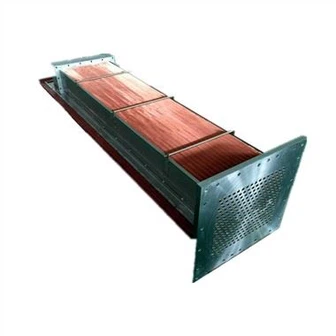
Adopt spiral high-flow finned tube structure with enlarged channel gaps to reduce sludge adhesion;
Add dedicated bypass flushing ports on VRCOOLER waste heat recovery exchangers for online chemical cleaning without disassembly;
Supply anti-scaling internal coating for tube bundles to slow mineral sediment accumulation.
3. Temperature & Safety Restrictions for Compressor Normal Operation
Challenge
The compressor has strict operating temperature thresholds:
Lubricating oil temperature must stay within 80–95°C; if the heat recovery system extracts too much heat and cools oil excessively, condensation of water vapor inside the compressor will dilute lubricant, trigger component corrosion and shorten service life.
Conversely, blocked heat exchangers cause poor heat dissipation, leading to compressor overheating, automatic shutdown and production interruption.
Solution
VRCOOLER heat recovery units come with dual-temperature interlock protection:
Low oil temperature trigger: Auto open bypass loop to reduce heat exchange load;
High oil temperature alarm: Increase circulating medium flow to boost heat removal.
The finned tube design ensures uniform heat transfer without local overcooling or overheating of compressor media.

4. Low-Grade Waste Heat Limits Application Scope
Challenge
Most oil-injected screw compressors only generate low-temperature waste heat (circulating hot water at 45–75°C). This low-grade thermal energy cannot support high-temperature industrial processes such as sterilization, high-temperature drying or steam production, limiting usable scenarios. In cold winter areas, heat loss through long transmission pipelines further reduces available heat temperature.
VRCOOLER Optimization
Custom high-density finned tube heat exchangers for oil-free air compressors to capture 120–160°C compressed air waste heat for higher-temperature hot water output;
Design compact heat exchangers installed close to compressors to shorten pipeline distance and cut heat loss; match external pipeline with thick insulation layers.
5. Complex Installation & Space Limitations
Challenge
Traditional waste heat recovery systems add extra heat exchangers, pumps, tanks and control cabinets. Many factories have compact compressor rooms with limited floor space, making layout and pipeline reconstruction difficult. Retrofitting old air compressors often requires large-scale piping modification, long construction cycles and temporary production downtime.
VRCOOLER Advantages
Finned tube heat exchangers feature compact, modular structure with smaller footprint than shell-and-tube models. VRCOOLER provides skid-mounted integrated heat recovery packages (heat exchanger + pump + valve + control cabinet) for fast on-site assembly, minimizing construction time and space occupation.
6. Corrosion Risks Under Special Working Conditions
Challenge
Compressor flue gas / exhaust air contains trace acidic substances from oil oxidation;
Circulating water with high chloride or ion concentration causes tube wall corrosion, especially for long-term continuous operation.
Corroded tubes lead to medium leakage (oil-water mixing risk) and frequent equipment replacement.
VRCOOLER Material Matching
Select customized finned tube materials based on working fluid:
Stainless steel 304/316 tube bundles for acidic exhaust and hard water;
Aluminum alloy anti-corrosion fins with protective coating for air-side heat exchange; fully isolate oil and water loops to prevent cross-contamination.
7. Uneven Heat Distribution & Low Overall Recovery Efficiency
Challenge
Single-pass plain tube heat exchangers create flow dead zones, resulting in uneven temperature distribution inside the equipment. A large portion of waste heat escapes through the original air cooling radiator instead of being recovered, lowering total heat capture rate below 70% in poor designs.
VRCOOLER Structural Improvement
Staggered spiral finned tube layout eliminates flow dead zones, maximizes contact area between hot media and cold circulating fluid, lifting waste heat recovery efficiency above 90% under standard operating conditions.