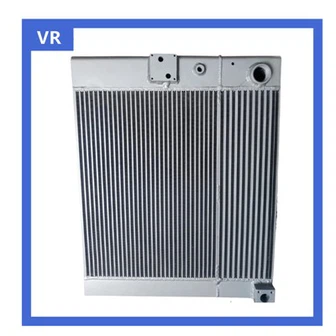
What Are The Advantages Of H-type Dry Coolers Compared To V-type Dry Coolers?
The H-shaped fin channel is straight, the airflow does not turn, and there is less dust accumulation; The soot blower has a good blowing effect and can efficiently clean the soot online.
The airflow resistance channel is straight, with low wind resistance (20% -40% lower than spiral fins), low fan energy consumption, and better investment and operating costs for induced draft fans.
The maintenance and lifespan control are arranged in a sequential manner, with independent modules and sufficient maintenance space; The elbow weld is located on both sides, reducing wear and leakage, and increasing lifespan by 3-4 times.
Uniformity of airflow in a series of tube bundles with segmented channels, resulting in a more uniform distribution of airflow and stable heat transfer efficiency, avoiding local overheating.
The anti vibration and anti-wear structure has strong rigidity, good anti vibration and anti fly ash wear performance, and is suitable for high dust and particulate flue gas working conditions.
The heat exchange area is slightly smaller than that of a single module, but occupies a relatively larger area
Cost and flexibility: The initial investment is slightly higher, and modular expansion is flexible.

H-type better scenario:
High dust/particulate flue gas (such as power plant boiler exhaust, cement kiln tail, metallurgical sintering) requires long-term stable operation and online ash cleaning.
High load, long-term industrial cooling (such as chemical process cooling, refrigeration unit condensation heat recovery), prioritize reducing energy consumption and maintenance costs.
Systems with high requirements for airflow uniformity and equipment lifespan, such as waste heat recovery for heating water and low-temperature economizers.
V-shaped better scenario:
Small and medium-sized systems with limited space, such as commercial building refrigeration and small-scale industrial cooling, pursue compact layout and low initial investment.
Clean environment (such as data center liquid cooling, food processing cooling), low risk of dust accumulation, and can leverage the advantage of heat exchange area.
For projects that require rapid deployment and modular expansion, V-shaped splicing is more flexible.