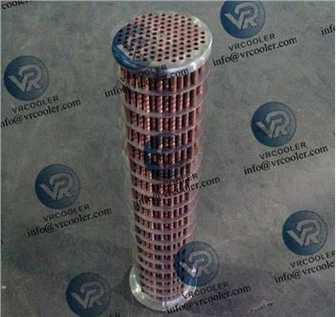
Steam Turbine And Hydraulic Turbine Generator Coolers
Steam Turbine and Hydraulic Turbine Generator Coolers
As core equipment in power systems, steam turbine generators and hydro turbine generators generate significant heat during operation due to electromagnetic and mechanical losses. Without timely cooling, this heat can cause insulation material aging, reduced equipment efficiency, or even failure. Coolers are critical auxiliary equipment ensuring their safe and stable operation.
Tube-Fin Cooler (Air-Water / Hydrogen-Water Universal)
This is the mainstream design for generator coolers, particularly suited for indirect cooling systems (e.g., air-water heat exchange in air-cooled units, hydrogen-water heat exchange in hydrogen-cooled units). Its structure and principle are as follows:
Structural Components:
Tube Bundle: The core heat transfer component, consisting of copper/stainless steel heat transfer tubes (through which cooling water flows) and aluminum/copper fins (wrapped/extruded around the tubes to increase heat transfer area);
Header: Divided into inlet and outlet chambers for cooling water distribution and collection; sealed headers are used in high-pressure scenarios (e.g., hydrogen cooling);
Shell/Frame: Secures the tube bundle, forming enclosed flow channels (e.g., hydrogen passages in hydrogen cooling, air passages in air cooling);
Working Principle:
The heat-transfer medium (air/hydrogen) flows outside the tubes, transferring heat to the heat-transfer tubes via fins. Cooling water flowing inside the tubes absorbs this heat and discharges it, achieving heat exchange.
Advantages: Large heat-transfer surface area (fins increase surface area by 5-10 times), high heat-transfer efficiency, suitability for high-velocity media (e.g., hydrogen), and moderate cost.

Cooling Method Classification
Air Cooling (Air-Cooled)
Core Principle: Air serves as the sole cooling medium. Fans force airflow over the motor stator, rotor windings, and core to directly dissipate heat (small units); or air absorbs motor heat before exchanging it with water via an "air-water cooler" (medium-to-large units, known as "indirect air cooling").
Applicable Scenarios: Small-to-medium steam turbine generators (power ≤50MW), medium-to-low speed hydro turbine generators (e.g., impulse hydro generators)
Advantages: Simple structure, no water leakage risk, low maintenance costs, minimal water quality requirements
Disadvantages: Low specific heat capacity of air and inefficient heat transfer make it unsuitable for high-power units; requires regular air filter cleaning to prevent dust clogging
Water Cooling (Water-Cooled)
Core Principle: Utilizes pure water/deionized water as the cooling medium, directly dissipating winding loss heat through hollow conductors embedded within the stator (or rotor) windings; the core still requires auxiliary air cooling Applicable Scenarios: High-power steam turbine generators (300MW and above), high-speed hydro turbine generators (e.g., mixed-flow hydro turbine generators)
Advantages: Water's high thermal conductivity (tens of times greater than air) enables superior cooling efficiency, allowing for reduced motor size and increased power density.
Disadvantages: Strict water quality control is required (corrosion and scale prevention), with risks of insulation damage from leaks; the system necessitates water treatment equipment (e.g., ion exchangers).
Hydrogen Cooling (Hydro Cooling)
Core Principle: Hydrogen (≥98% purity) serves as the cooling medium, filled within the motor's sealed casing. After absorbing motor heat, hydrogen transfers heat to water via a "hydrogen-water cooler" (core concept: hydrogen replaces air to enhance heat transfer efficiency).
Applicable Scenarios: Large steam turbine generators (100MW and above, especially for thermal power units), certain giant hydroelectric generators.
Advantages: Hydrogen's specific heat capacity is 1.4 times that of air, and its thermal conductivity is 7 times higher, resulting in high cooling efficiency. Hydrogen's low density reduces rotor wind resistance losses (5%-10% energy savings).
Disadvantages: Strict sealing required to prevent leaks (hydrogen is flammable and explosive, necessitating explosion-proof and leak detection equipment); complex system (requires hydrogen source, dehumidification, and purification equipment), high maintenance costs