Steam Power Generation Units: Air-Cooled / Hydrogen-Cooled Cooler
Steam Power Generation Units: Air-Cooled / Hydrogen-Cooled Cooler
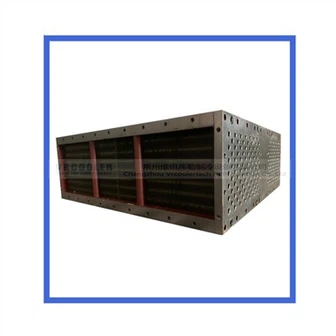
Generator Air Cooler
Function: Directly cools the generator's stator, rotor, and core using air (commonly used in small and medium-sized steam turbine generators).
Structure:
Copper tubes with aluminum fins
Built-in fan (rotor-driven or independent fan)
Air circulates within the unit and is cooled by external water or air through the air cooler
Features:
Simplest structure, lowest cost, and easiest maintenance
No explosion-proof or sealing requirements
Lower heat dissipation efficiency (poor thermal conductivity of air)
Applicable Capacity: Generally ≤60 MW small steam turbine generators
Generator Hydrogen Cooler
Function: Uses hydrogen as an internal circulation medium to cool the generator, then transfers the heat from the generator to the cooling water via the hydrogen cooler.
Principle:
The generator is filled with high-purity hydrogen (>98%) at 0.3–0.5 MPa
The thermal conductivity of hydrogen is approximately 7 times that of air, and its density is only 1/14 that of air
The hot hydrogen is cooled by cooling water in the hydrogen cooler and then recirculated
System Components (more than just a single cooler):
Hydrogen cooler body (4–6 units in parallel)
Sealing oil system (leak prevention)
Hydrogen drying, purity monitoring, pressure control, and explosion protection
Applicable Capacity:
60 MW–450 MW: Pure hydrogen cooling
450 MW–1,800 MW: Rotor hydrogen cooling + stator water cooling (dual water internal cooling)