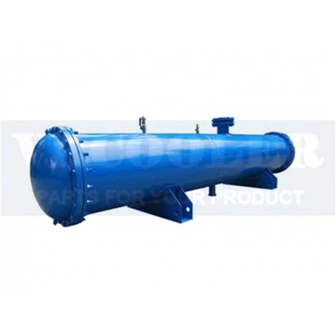
Nuclear Power Plant Fuel Cooler
Nuclear Power Plant Fuel Cooler
In a nuclear power plant, a Fuel Oil Cooler (FOC) is an important auxiliary equipment mainly used to cool fuel oil or lubricating oil used in a nuclear power plant. Although the main source of energy in a nuclear power plant is the nuclear reactor, the use of fuel or lubricating oil is essential in certain auxiliary systems such as diesel generator sets, emergency power systems or lubrication systems. The role of the fuel cooler is to ensure that these oil media are kept at a suitable temperature during operation to prevent equipment failure or loss of efficiency due to overheating.
Functions of fuel coolers
Cools the fuel or lubricating oil:
In a diesel generator set or lubrication system, fuel or lubricating oil generates heat during operation due to friction and compression. The fuel cooler carries this heat away through cooling water or other cooling media to maintain the oil temperature within a reasonable range.
Improves equipment efficiency:
Excessive oil temperatures can reduce lubrication, increase mechanical wear, and even lead to equipment failure. Fuel coolers ensure efficient equipment operation by controlling oil temperature.
Extend equipment life:
Through effective cooling, the fuel cooler reduces thermal stress and wear and tear on the equipment, extending its life.
Ensure system safety:
Diesel generator sets are key equipment in the emergency power system of a nuclear power plant. The fuel cooler ensures the normal operation of the fuel system of the diesel generator set, thus guaranteeing the safety of the nuclear power plant.
Structure and working principle of fuel cooler
Fuel coolers are usually of Shell and Tube Heat Exchanger (Shell and Tube Heat Exchanger) or Plate Heat Exchanger (Plate Heat Exchanger) design. The following is a typical structure of a Shell and Tube Fuel Cooler:
Shell:
The shell is the external structure of the fuel cooler and is usually made of a corrosion-resistant material such as carbon steel or stainless steel.
Tube bundle:
The tube bundle consists of a number of metal tubes, with cooling water flowing inside the tubes and fuel or lubricating oil flowing outside the tubes (shell side). Heat is transferred from the oil to the cooling water through the tube walls.
Cooling Water System:
Cooling water enters the tube bundle from one end, absorbs heat and exits from the other end. The cooling water can be recycled water or from an external water source.
Folding Plate:
Folding plates are installed in the housing to increase the flow path of the oil and improve heat transfer efficiency.
Sealed structure:
Fuel coolers need to have good sealing to prevent oil or cooling water leakage.

Characteristics of fuel cooler
Highly efficient heat transfer:
Fuel coolers are designed with high efficiency heat transfer to quickly transfer heat from the oil to the cooling water.
Corrosion Resistant:
Fuel oil and cooling water can be corrosive to equipment, so fuel coolers are often manufactured from corrosion-resistant materials such as stainless steel.
Compact design:
Fuel coolers are often compactly designed to fit within the space constraints of a nuclear power plant.
Ease of Maintenance:
Fuel coolers have removable tube bundles or plate sheets for easy cleaning and maintenance.
Operation and Maintenance of Fuel Coolers
Operation Monitoring:
During operation, real-time monitoring of oil temperature, pressure and cooling water flow is required to ensure cooling effectiveness.
Prevent leakage:
Regularly check the sealing of the fuel cooler to prevent oil or cooling water leakage.
Regular cleaning:
Impurities in the cooling water may be deposited in the tube bundles or plates, affecting the heat transfer efficiency, so regular cleaning is required.
Check for corrosion:
Regularly check the corrosion of the fuel cooler, especially the tube bundle or plate sheet, and replace the damaged parts in time.
Fuel cooler selection and design considerations
Cooling capacity:
According to the heat generation of the fuel system, select the appropriate fuel cooler capacity.
Material Selection:
According to the nature of fuel and cooling water, select corrosion-resistant and high-temperature-resistant materials.
Space constraints:
Consider the installation space of the nuclear power plant and design a compact fuel cooler.
Energy efficiency optimization:
Improve the energy efficiency of the fuel cooler by optimizing the heat transfer design and cooling water flow.
Application Scenarios for Fuel Coolers
Diesel generator sets:
Diesel generator sets are key equipment in the emergency power systems of nuclear power plants. Fuel coolers are used to cool the fuel system of diesel generator sets to ensure their normal operation.
Lubrication system:
In the turbines, pumps or other rotating equipment of nuclear power plants, fuel coolers are used to cool the lubricating oil and ensure the lubrication effect of the equipment.
Auxiliary Systems:
In other auxiliary systems in a nuclear power plant, fuel coolers may also be used to cool hydraulic oil or other oil media.