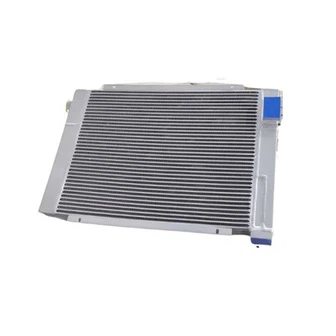
MTU 20V4000FB Biogas Remote Radiator For CHP Power Plant Cooling
When people refer to an MTU 20V4000FB biogas remote radiator, they are usually talking about a remote cooling package engineered for the mtu Series 4000 20-cylinder biogas genset platform. In MTU's current published 60 Hz biogas literature, the 20-cylinder versions are listed as mtu 20V4000 GS L32FB and mtu 20V4000 GS L64FB, and those published ratings are the right starting point for radiator sizing, fan selection, circuit separation, and control strategy.

For biogas plants, a remote radiator is often a practical choice because it moves the heat rejection equipment away from the engine room, lowers indoor heat buildup, simplifies ventilation design, and gives the EPC more freedom in layout. That matters in agricultural digesters, wastewater treatment plants, and landfill-gas installations, where the generator hall is often compact and the cooling system has to work reliably in dirty outdoor environments. MTU positions the Series 4000 biogas range specifically for those kinds of applications, with the product family covering biogas power generation for farms, sewage and wastewater plants, and landfill operators.
From the engine side, the 20-cylinder Series 4000 biogas platform is a 90° V engine with 20 cylinders, 170 mm bore, 210 mm stroke, 4.77 liters displacement per cylinder, about 95.4 liters total displacement, and a rated speed of 1500 rpm. MTU's current drawings also show the packaged 20V4000 genset footprint at approximately 7250 × 2000 × 2600 mm, which is useful when planning radiator pipe routing, pump head, and cable corridor separation between the engine package and the outdoor cooler bank.
The most important point for radiator engineering is not just engine output, but how much heat must actually be rejected by the cooling circuits. For the published 20V4000 GS L32FB biogas ratings at 60 Hz, MTU lists about 1932–1934 kWe electrical output, 745–797 kW thermal output from engine cooling, and 373–425 kW low-temperature heat. For the 20V4000 GS L64FB biogas rating, MTU lists about 2521 kWe electrical output, 1538 kW thermal output from engine cooling, and 128 kW low-temperature heat. If a remote radiator is designed to reject both the main engine-cooling load and the low-temperature circuit, the radiator duty basis is therefore roughly 1118–1222 kW for the 20V4000 L32FB variants and about 1666 kW for the 20V4000 L64FB variant. Those totals are engineering inferences obtained by combining MTU's published engine-cooling and low-temperature heat figures; they are not a separate official MTU radiator rating.
That distinction is important because CHP plants do not all reject heat the same way. Some projects recover part of the jacket-water heat into a hot-water loop, some prioritize engine-room-free dry cooling, and some recover exhaust heat with a dedicated heat recovery module while sending only HT/LT liquid circuits to the remote cooler. MTU's own biogas data sheets explicitly note that different flow and return temperatures, hot cooling arrangements, methane number, and installation conditions are project-specific, which means the final radiator selection must be matched to the exact site duty rather than copied from a generic engine brochure.
For that reason, a well-designed MTU 20V4000FB remote radiator is usually configured as either a dual-circuit HT/LT radiator or a single assembled cooler with separate coils and headers. The high-temperature section handles the main engine jacket-water load, while the low-temperature section deals with charge-air or auxiliary low-temp cooling, depending on the package design. In practice, that means selecting coil surface, tube rows, fin pitch, fan quantity, and motor power around three real project variables: ambient design temperature, required coolant outlet temperature, and allowable pressure drop. On biogas sites, designers also need to consider corrosive atmosphere, fouling risk, and seasonal load variation, because radiator under-sizing causes power derate in summer while over-aggressive fan control wastes parasitic power in winter.
For the MTU Series 4000 biogas platform, the remote radiator should also be treated as part of the plant's control philosophy, not just a passive heat exchanger. MTU highlights electronic gas metering, automatic knocking control, and integrated control architecture in the Series 4000 biogas package, so the cooling system needs stable temperature control to support knock margin, combustion stability, and full-load availability. In real terms, that means using VFD or EC fan control, staged fan logic, properly sized circulation pumps, and a control sequence that keeps coolant temperatures steady during load changes instead of allowing wide thermal swings.
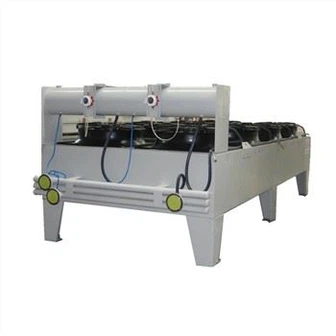
A strong radiator package for this engine class is usually built around heavy-duty finned coils, galvanized or painted structural steel, weather-protected motors, maintenance-friendly fan guards, and headers sized for low velocity and even flow distribution. In harsher biogas environments, epoxy-coated fins, corrosion-protected fasteners, and conservative fin spacing are often better choices than pushing for maximum compactness. The goal is not only peak heat rejection on day one, but stable performance after years of dust, moisture, and outdoor exposure.
Another reason the MTU 20V4000 biogas platform is a serious radiator application is the engine's power density. MTU markets the Series 4000 biogas family as a high power-density range for continuous biogas service, with 20-cylinder output up to roughly 2520 kWe at 60 Hz, electrical efficiency around 42.6%, and total efficiency approaching 89.7% on the published L64FB configuration. MTU also states that the Series 4000 biogas line is designed for long service life, citing 84,000 operating hours between overhauls for the platform family. For radiator suppliers, that means the cooling package must be engineered as long-life infrastructure rather than as a light industrial accessory.
In project terms, the best article headline is not simply "radiator for MTU engine," but remote dry cooling for a high-output biogas CHP package. The radiator has to protect electrical output, preserve engine reliability, and maintain thermal stability under changing methane quality, ambient conditions, and plant heat-recovery strategy. When it is correctly matched to the official 20V4000 biogas heat balance, the remote radiator becomes a critical part of overall plant efficiency, uptime, and lifecycle economics rather than just an auxiliary cooler.