Lower Guide Bearing Oil Coolers | VRCOOLER
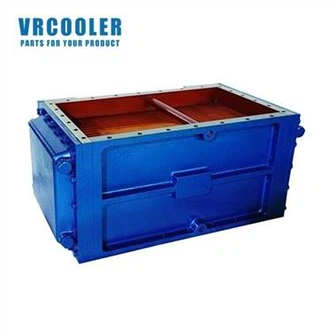
For hydroelectric power plants, pumped-storage stations, large vertical pumps, and heavy turbomachinery, VRCOOLER custom-engineers and manufactures heavy-duty Lower Guide Bearing Oil Coolers. Positioned in the oil reservoir directly above the turbine runner and below the generator rotor, the lower guide bearing is subjected to high axial/radial shaft loads, intense rotational friction, and hydraulic turbulence. VRCOOLER lower guide bearing oil coolers maintain lubricating oil viscosity (+40°C to +50°C) to protect Babbitt-lined bearing pads from thermal deformation, wipe failure, and cavitation. Available in curved arc-segment, multi-module circular, and external plug-in shell-and-tube configurations, our coolers utilize seamless CuNi 90/10, deoxidized copper, or 316L stainless steel finned and smooth tubes with helium-tight double-grooved tube rolling or orbital TIG seal welding. Engineered to handle raw river water, high silt loads, and aggressive dissolved minerals, VRCOOLER delivers 100% 1:1 drop-in replacements and OEM retrofit solutions designed for 30+ years of maintenance-free operation.

Operating Environment & Challenges of Lower Guide Bearing Cooling
In vertical hydro-generator units, the Lower Guide Bearing is located closest to the water runner. This location exposes the bearing oil cooling system to severe mechanical and environmental stresses:
Critical Operational Challenges:
High Heat Flux & Thermal Runaway Risks: Friction between the rotating shaft journal and stationary Babbitt bearing pads generates intense localized heat. If oil temperature exceeds safe thresholds (>+65°C), oil film thickness collapses, leading to direct metal-to-metal contact, Babbitt melting, and catastrophic turbine tripping.
Strict Physical Space Restrictions: The lower guide bearing oil reservoir is tightly integrated into the turbine head cover or lower bracket, leaving very narrow circular annular clearance for cooler installation.
Raw River Water Fouling, Silt & Sand Abrasion: Cooling water drawn directly from the penstock, tailrace, or river contains abrasive quartz silt, suspended solids, and biological algae that erode tube inner walls and block cooling passages.
Severe Hydraulic & Mechanical Vibration: Low-frequency pressure pulsations from the turbine draft tube, runner vortex ropes, and shaft runout transmit intense vibration into the cooler bundle, risking tube-to-tubesheet joint fatigue and weld cracking.
Absolute Zero-Water-Leakage Mandate: Any internal cooling water leakage into the bearing oil bath causes rapid oil emulsification, loss of lubricating film strength, and immediate bearing destruction.
VRCOOLER Design Configurations for Lower Guide Bearing Oil Coolers
At VRCOOLER, we provide three distinct structural architectures engineered to fit any hydro turbine or vertical pump configuration:
1. Annular Arc-Segment Coolers (Internal Oil Bath Immersed)
Modular Arc Segments: Fabricated in 2,4,6, or 8 curved arc sections that assemble into a complete ring inside the annular oil reservoir around the turbine shaft.
Individual Segment Isolation: Each segment features independent inlet/outlet water isolation valves, allowing single-segment maintenance or flushing without draining the entire bearing oil sump.
Natural Convection & Forced Oil Circulation: Positioned directly in the oil circulation path driven by the rotating bearing oil runner or pump impellers.
2. Multi-Row Finned / Bare U-Tube Assemblies
High-Efficiency Integral Finned Tubes: Low-fin copper or CuNi tubes maximize external heat transfer surface area within extremely confined oil bath volumes.
Smooth Bare Tubes for High-Silt Water: Heavy-wall bare tubes with optimized internal water velocity (1.2−2.0 m/s) prevent suspended silt sedimentation and abrasion.
Unrestricted U-Bend Thermal Expansion: Floating U-tube bends allow free axial expansion during rapid turbine start-up and load rejection cycles.
3. External Skid-Mounted Shell-and-Tube Coolers
Forced Circulation Systems: For modern or upgraded power plants, VRCOOLER provides external shell-and-tube or double-tube safety heat exchangers mounted adjacent to the turbine pit.
Duplex Standby Architecture: 2×100% redundant cooler skids with automated three-way changeover valves for continuous operation during cleaning.
Advanced Materials & Zero-Leakage Manufacturing
VRCOOLER applies nuclear- and marine-grade manufacturing standards to eliminate the risk of water ingress into bearing oil:
1. Robust Corrosion- & Silt-Resistant Metallurgy
Seamless CuNi 90/10 (UNS C70600): Superior resistance to chloride pitting, microbial corrosion, and river water erosion.
High-Conductivity Phosphorus-Deoxidized Copper (SF-Cu / C12200): Maximum thermal conductivity for compact oil sumps with clean closed-loop cooling water.
Heavy-Wall Stainless Steel (SS304L / SS316L / Duplex 2205): Engineered for aggressive, acidic mine drainage water or river water with high dissolved solids.
2. Zero-Leakage Double-Barrier Joints
Double-Grooved Hydraulic Tube Expansion: Tube ends are expanded into double-serrated CNC-machined tubesheet holes, delivering exceptional mechanical pull-out strength and high-pressure sealing.
Orbital TIG Seal Welding: For stainless steel and titanium configurations, automated orbital TIG welding fuses the tube-to-tubesheet joint, followed by precision dye penetrant (PT) and helium leak testing.
Optional Double-Tubesheet Construction: Features an intermediate air gap between the water and oil chambers; any leakage is safely vented to an external drain without contacting the bearing oil.
1:1 Replacement & Retrofit for Existing Power Plants
During turbine overhauls and life-extension modernizations, replacing deteriorated bearing oil coolers with original OEM components often presents extreme challenges due to obsolete drawings or unavailable original fabricators. VRCOOLER provides seamless retrofit solutions:
1:1 Drawing-Based Replication: We manufacture exact replacement arc segments or complete circular cooler assemblies matching original radius, mounting brackets, water pipe connections, and bolt pitch circles.
On-Site 3D Laser Scanning & Reverse Engineering: When original drawings are missing, our engineering team utilizes on-site 3D scanning or dimensional surveys of existing coolers during turbine teardown to recreate exact fabrication models.
Thermal Performance Modernization: Upgrading from aging plain tubes to advanced low-fin CuNi 90/10 or high-flux stainless steel tubes increases cooling capacity by 20%−35% within the same physical envelope, accommodating turbine power uprates.
Why Hydro Plant Operators & Turbine OEMs Choose VRCOOLER
Hydroelectric utilities, EPC contractors, and turbine service providers globally rely on VRCOOLER:
Uncompromising Zero-Leakage Reliability: Every cooler undergoes rigorous 100% helium mass spectrometer leak detection and hydrostatic pressure testing at 1.5× design pressure before leaving our factory.
Anti-Clogging & Silt-Tolerant Hydrodynamics: Tube internal water velocities and header flow passages are optimized using CFD modeling to prevent silt settling and sand erosion in run-of-river stations.
Complete Material Traceability: Supplied with full EN 10204 Type 3.1 material test certificates, chemical analysis, mechanical test reports, and non-destructive testing (NDT) records.
Fast Emergency Replacement Delivery: Accelerated manufacturing protocols designed to meet tight planned generator outage and drydock schedules.
Frequently Asked Questions (FAQ)
Q1: Why is the lower guide bearing oil cooler more susceptible to silt erosion than upper bearing coolers?
A: In vertical hydro units, the lower guide bearing is located at the lowest elevation in the powerhouse, closest to the penstock and tailrace cooling water takeoff lines where raw river water carries the highest concentration of heavy sediment, sand, and quartz silt. VRCOOLER utilizes erosion-resistant CuNi 90/10 or heavy-wall stainless steel tubes and controlled internal flow velocities to prevent erosion.
Q2: What is the advantage of segmented arc coolers over a single continuous ring cooler?
A: Segmented arc coolers can be easily installed, inspected, and removed through the tight access hatches of the turbine pit without dismantling the generator rotor, thrust bearing bracket, or shaft coupling. Additionally, individual segments can be valved off independently for maintenance while the turbine continues operating safely.
Q3: What information is required to design or quote a replacement lower guide bearing cooler?
A: Please provide the turbine bearing heat rejection load (kW), bearing oil flow rate and viscosity grade (ISO VG 46/68), cooling water inlet temperature and available pressure, physical dimensions (outer radius, inner radius, height), and connection flange sizes. Existing equipment nameplate photos or original layout drawings are also highly helpful.
Q4: Can VRCOOLER manufacture double-tubesheet bearing coolers for critical safety installations?
A: Yes. For high-head pumped-storage plants and critical installations requiring total water/oil isolation, VRCOOLER manufactures double-tubesheet bearing coolers. Any leak at the tube-to-tubesheet joint is discharged safely through an intermediate drain cavity equipped with moisture sensors, preventing any water from entering the bearing oil reservoir.
Request a Lower Guide Bearing Oil Cooler Quotation
Protect your hydro turbines, vertical generators, and heavy rotating machinery with precision-engineered oil coolers from VRCOOLER.
Explore Hydro Power Heat Transfer Solutions: Visit www.vrcooler.com
Submit Your Bearing Cooler RFQ: Contact our hydro engineering division directly at [email protected] with your bearing oil heat balance data, dimensional constraints, and equipment drawings for an immediate technical assessment and quotation.