Hydrogen Coolers For Turbogenerators (H2 Gas Coolers) | VRCOOLER
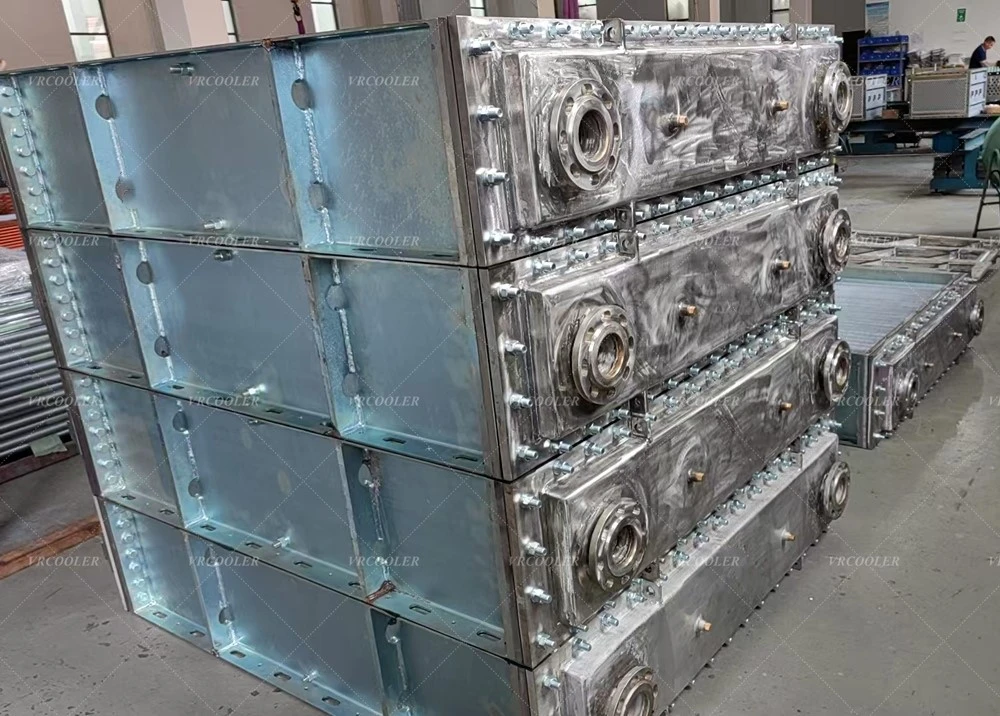
For utility-scale thermal, combined-cycle gas turbine (CCGT), nuclear, and large industrial power generation plants operating 50 MW to 1,000+ MW high-speed turbogenerators (2-pole / 4-pole, driven by GE, Siemens Energy, Mitsubishi Power, Alstom, Westinghouse, or Ansaldo Energia), VRCOOLER custom-engineers and manufactures heavy-duty Hydrogen Coolers (H2 Gas-to-Water Heat Exchangers). Hydrogen gas (H2) offers a thermal conductivity ∼7× higher and a density ∼1/14th that of air, dramatically reducing windage losses and enabling ultra-compact stator/rotor core heat dissipation. Pressurized hydrogen gas (2.0 to 5.0 bar(g) / 30 to 75 psig) circulated through the generator windings absorbs 500 kWth to 6,000+ kWth of stator iron and rotor copper electrical losses. VRCOOLER Hydrogen Coolers (typically arranged in 2, 4, or 6 modular sections installed horizontally or vertically within the generator stator frame enclosure) cool hot circulating hydrogen from +65°C to +80°C (+149°F to +176°F) down to a stable +38°C to +46°C (+100°F to +115°F) using plant closed-cooling water (CCW), cooling tower water, or raw river/sea water. Engineered with seamless CuNi 90/10, SS316L, or Titanium Grade 2 tubes, extruded bimetallic aluminum high-fins, explosion-proof gas-tight roller-expanded tubesheets, and 100% helium mass-spectrometer leak testing (<10−6 mbar⋅L/s), our coolers guarantee zero hydrogen gas leakage, prevent water ingress, and comply with ASME Section VIII Div. 1, TEMA Class C/R, and global power generation standards.
Critical Hydrogen Cooler Engineering Challenges Solved by VRCOOLER:
100% Hermetic Hydrogen Gas-Tight Sealing: Hydrogen is the smallest molecular gas and easily permeates microscopic voids. VRCOOLER utilizes precision CNC double-grooved tubesheet hole geometry with automated torque-controlled roller expansion and seal welding, subjected to 100% Helium Mass Spectrometer vacuum chamber leak testing to ensure zero hydrogen leakage into the cooling water stream.
Water Ingress Prevention into Stator Chamber: A tube breach inside a hydrogen-cooled generator allows pressurized water to contaminate the hydrogen atmosphere, degrading gas purity (<95% H2 raises flammability risks) and causing stator dielectric flashover. VRCOOLER incorporates thick-walled seamless tube alloys (min. 1.2−1.65 mm wall) and offers double-tube safety matrices with electronic leak detection.
High Heat Transfer on Low-Density Gas Side: Although hydrogen has exceptional thermal conductivity, its low density requires optimized gas-side surface area. VRCOOLER engineers bimetallic extruded aluminum high-fins (9 to 12 fins per inch, 0.4−0.5 mm thickness) providing massive surface area with low aerodynamic gas pressure drop (<1.2−2.5 kPa).
Resistance to Severe Cooling Water Corrosion: Raw river or estuary water contains abrasive silt, chlorides, and biological organisms. VRCOOLER specifies seamless CuNi 90/10 (UNS C70600), Admiralty Brass, or pure Titanium Grade 2 tubes paired with cast marine bronze or stainless steel waterboxes.
At VRCOOLER, hydrogen cooler bundles are custom-engineered for direct horizontal or vertical insertion into turbogenerator stator frames:
1. Gas-Tight Tubesheet & Channel Header Construction
Heavy Forged Naval Brass / Stainless Steel Tubesheets: Forged plates precision-machined with double-serrated grooves ensure leak-tight tube joints rated for test pressures up to 25 bar (360 psig).
Removable Waterbox Channel Covers: Enables mechanical brush or hydro-jet tube cleaning during plant overhaul outages without disturbing the generator's internal hydrogen gas sealing.
Modular Multi-Pass Flow Layouts: Available in 2-pass, 4-pass, or multi-pass water circuits to match available plant cooling water flow rates and velocity windows (1.5−2.2 m/s).
2. High-Integrity Finned Tube Matrix
Inner Tube Alloys: Seamless CuNi 90/10, CuNi 70/30, SS304L, SS316L, or Titanium Grade 2.
Extruded Aluminum Bimetallic Fins (Type G / Type L / Extruded High-Fin): Extruded aluminum sleeve mechanically bonded over the base tube under high radial pressure, forming a continuous metallic bond that resists thermal cycling from +20°C to +120°C without fin loosening.
3. Structural Slide-In Mounting Frames
Roll-In Guide Rails & Lifting Lugs: Rigid structural stainless steel or coated carbon steel frames equipped with slide-in guide rollers, positioning stops, and high-temperature Viton / EPDM hydrogen perimeter sealing gaskets for rapid dry outage installation.
When power utility hydrogen coolers suffer from tube thinning, erosion-corrosion, galvanic attack, or fin degradation, VRCOOLER provides direct 1:1 drop-in replacement bundles:
1:1 Dimensional Fit: Precise replication of overall bundle length, tubesheet bolt circle, guide rail centerline, water nozzle orientation, and stator perimeter seal frame. Fully compatible with legacy equipment from GE, Siemens, Westinghouse, Alstom, Parsons, ABB, and Mitsubishi.
Material Upgrades for Life Extension: Upgrade older plain copper or carbon steel bundles to corrosion-proof CuNi 90/10, SS316L, or Titanium Grade 2 to permanently resolve river silt erosion and pitting.
Emergency Outage Fabrication: Dedicated fast-track production lines engineered to deliver replacement bundles directly to power plant sites within tight scheduled outage turnaround windows.
Key Advantages of Partnering with VRCOOLER for Hydrogen Coolers
Zero-Leakage Helium Mass Spectrometer Testing: Every hydrogen cooler bundle undergoes rigorous 100% helium vacuum chamber leak detection to guarantee absolute gas containment.
Engineered for High Hydrogen Purity: Clean, passivated internal tube and fin surfaces prevent hydrogen contamination and maintain maximum cooling gas density.
Thermal Performance Guarantee: Precision thermodynamic modeling ensures the generator operates comfortably within Class F/H winding temperature rise limits, preventing power derating during summer peak ambient conditions.
Complete Quality & Code Certification: Supplied with EN 10204 3.1 material test certificates, hydrostatic test reports, NDT documentation (radiographic/dye penetrant/eddy current), and ASME Section VIII U-Stamp / PED certification.
Frequently Asked Questions
Q1: Why is hydrogen used instead of air for cooling large power generators?
A: Hydrogen gas has a thermal conductivity approximately 7× higher than air (enabling much faster heat transfer from stator and rotor windings) and a density roughly 1/14th1/14th that of air (dramatically reducing rotor aerodynamic windage losses). This allows hydrogen-cooled generators to achieve efficiencies exceeding 98.5%−99% in a much smaller physical footprint than air-cooled units.
Q2: How does VRCOOLER ensure that hydrogen gas does not leak into the cooling water?
A: Tubes are expanded into double-grooved tubesheets using automated torque-controlled CNC expanding systems, followed by mechanical seal welding where required. Every completed cooler bundle is placed in a vacuum testing chamber and tested with 100% Helium Mass Spectrometry to a leak rate threshold tighter than 1×10⁻⁶ mbar⋅L/s.
Q3: What cooling water mediums can be handled by VRCOOLER hydrogen coolers?
A: We design cooler bundles for closed-circuit demineralized cooling water (CCW) using CuNi 90/10 or SS304L/SS316L, open cooling tower water / river water using CuNi 90/10 or Admiralty Brass, and direct marine seawater using pure Titanium Grade 2.
Q4: What information is needed to quote a replacement generator hydrogen cooler?
A: Please provide the generator electrical rating (MW), OEM make/model, hydrogen gas operating pressure (bar or psig), number of cooler sections, cooling water inlet temperature and flow rate, and existing cooler nameplate photos or dimensional outline drawings.
Request a Generator Hydrogen Cooler Proposal
Safeguard utility turbogenerator reliability, eliminate hydrogen leakage risks, and optimize thermal performance with VRCOOLER.
Explore Generator Cooling Systems: Visit www.vrcooler.com
Submit Your Hydrogen Cooler RFQ: Send your generator equipment datasheets, dimensional drawings, and cooling water specifications directly to our power engineering division at [email protected] or WhatsApp +86 18136593690 for a detailed technical proposal, 3D CAD drawing, and quotation.