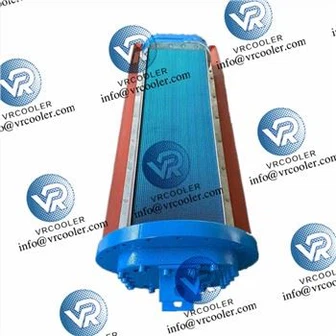
High And Low Temperature Dry Coolers Used in Nuclear Power Plants
Core Definition and Principles
Dry Cooler: Using ambient air as the cooling source and cooling the fluid (water/ethylene glycol/helium) inside the pipes through sensible heat exchange, it does not rely on water evaporation, saves water, and has a closed cycle.
High and low temperature dry coolers: divided into two categories based on the temperature range and function of the cooling object:
High temperature dry cooler: It cools high-temperature media (such as helium gas in high-temperature gas cooled reactors and cooling water for high-temperature equipment on nuclear islands), can withstand heat flow of 300-900 ℃, and is mostly made of high-temperature resistant alloys/stainless steel by the Central Commission for Discipline Inspection and Supervision.
Low temperature dry cooler: cools low-temperature fluids (such as condenser circulating water and equipment cooling water) in conventional islands/auxiliary systems, with a working temperature of 40-80 ℃, mainly made of carbon steel/stainless steel.
Working principle: hot fluid inside the tube → tube wall → fins → fan driven forced convection of air → heat is discharged into the atmosphere; Non powered dry coolers rely on natural convection/hot pressing to achieve passive heat dissipation.
Main application scenarios in nuclear power plants
1. Conventional island cooling system (mainstream pressurized water reactor)
Closed loop cooling of condenser: replacing seawater direct flow cooling, using dry coolers to cool circulating water, achieving zero water intake/discharge, and supporting inland nuclear power construction.
Equipment cooling water system (CCW): cools the steam turbine, generator, pump valves, etc. to maintain the equipment operating at the design temperature.

2. Nuclear Island Auxiliary and Safety System (Critical Safety Function)
Equipment cooling water system (RRI): It cools the reactor coolant pump, stabilizer, heat exchanger, etc. inside the nuclear island, and is the "main artery" for heat dissipation in the nuclear island.
Residual Heat Removal System (RHRS): After the reactor is shut down, the decay heat of the core is discharged, and the dry cooler is the core heat dissipation terminal of the Central Commission for Discipline Inspection and Supervision.
Non powered dry cooler inside the containment vessel: a key equipment of the fourth generation high-temperature gas cooled reactor (such as Shidao Bay), which passively discharges the heat from the containment vessel under accident conditions to ensure that the core does not melt.
Special for Fourth Generation High Temperature Gas Cooled Reactor (HTR-PM)
Helium circulation cooling: The main helium fan sends helium gas at 900 ℃ from the core to the steam generator. After cooling, the helium gas is further cooled by a high-temperature dry cooler and returned to the core to form a closed cycle.
Passive waste heat removal: relying on natural convection of non powered dry coolers, waste heat can still be removed even when the entire plant is shut down, achieving inherent safety for the Central Commission for Discipline Inspection and Supervision.
Other auxiliary scenarios
Nuclear Island Ventilation and Air Conditioning: Cooling the cooling unit of the nuclear island HVAC system to ensure the safety of the plant environment and equipment.
Spent fuel pool cooling: assists in removing the decay heat of spent fuel and enhances the redundancy of the cooling system.
Technical features and advantages
Significant Water Saving: Compared to wet cooling towers, it saves over 90% water and completely eliminates dependence on large amounts of freshwater/seawater.
Safe and reliable:
Closed loop, no risk of radioactive medium leakage.
Passive design (non powered dry cooler), can still work even in the event of a power outage, enhancing the ability to respond to accidents.
Strong adaptability:
The high-temperature dry cooler can withstand high temperature, high pressure, and corrosion, and is suitable for the harsh working conditions of fourth generation reactors under the supervision of the Central Commission for Discipline Inspection and Supervision.
Modular and compact design, suitable for installation in limited space on nuclear islands.
Easy operation and maintenance: no evaporation, no scaling, no floating water, low maintenance, long service life.
Typical application cases
Shandong Shidao Bay High Temperature Gas Cooled Reactor: The world's first commercial fourth generation reactor, which uses a large number of non powered dry coolers inside the containment vessel to achieve passive waste heat removal, which is the core guarantee of its inherent safety.
Inland Hualong One (Zhaoyuan, Shandong): For the first time, a combination of high-level water collection natural ventilation dry cooling tower and mechanical ventilation dry cooler is used to achieve secondary circulation cooling, allowing Hualong One to move inland.