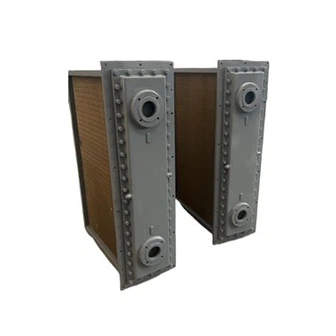
Forced Oil Circulation Air-Cooled Oil Cooler
Forced Oil Circulation Air-Cooled Oil Cooler
Forced oil circulation air-cooled heat exchangers are critical equipment that utilize air as the cooling medium to reduce oil temperature through industrial heat exchange principles.
The core principle involves indirect heat exchange between oil circulating under forced (pumped) circulation and air flowing under forced (fan-driven) convection. This transfers heat from the oil to the air, which is then dissipated into the atmosphere.
This principle can be broken down into three key components:
1. Forced Oil Circulation
Purpose: Ensures hot oil requiring cooling flows through the cooler at sufficient velocity and volume, providing a stable heat source.
Implementation: The system incorporates one or more oil pumps to extract high-temperature oil from equipment (e.g., power transformers, large motor bearing housings). The oil is pressurized and pumped into the heat exchange core of the cooler. The cooled oil is then returned to the equipment, forming a closed-loop circulation.
Significance of "forced": Actively overcomes flow resistance in the oil circuit to guarantee heat transfer efficiency and enables flow rate adjustment based on thermal load.
2. Heat Exchange Process (Core Component)
This physical process occurs within the cooler core, adhering to fundamental heat transfer principles:
Conduction: High-temperature oil flows along the inner surface of heat exchange tubes (typically smooth-walled). Heat transfers from the inner wall through the tube material (usually aluminum or copper) to the outer wall.
Convection:
Oil-side convection: Forced circulation by the oil pump induces high-velocity oil flow within the tubes, disrupting the thermal boundary layer near the tube walls and enhancing convective heat transfer between the oil and tube inner walls.
Air-side convection: Cool air is forcibly blown or drawn over the tube outer walls by a fan. These walls are equipped with fins (to increase heat dissipation area), which carry away heat from the tube walls.
Simply put, the heat transfer path is:
High-temperature oil → Tube inner wall → Tube wall material → Tube outer wall & fins → Moving air
3. Forced Air Cooling
Purpose: To provide a continuous cold source for heat exchange and rapidly remove absorbed heat.
Implementation: An axial fan is installed on one side or at the bottom of the cooler core. When the fan operates, it forces a large volume of ambient cool air to flow horizontally or vertically through the densely packed finned tube bundle.
The significance of "forced": Natural convection cooling is extremely inefficient and cannot meet industrial cooling demands. Forced ventilation significantly enhances the air-side heat transfer coefficient, making it crucial for achieving high-efficiency cooling.