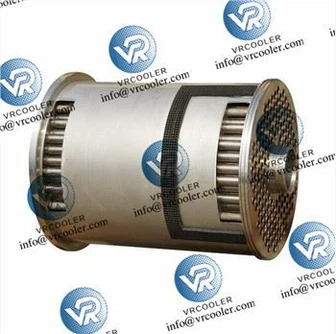
Custom Tube Fin Heat Exchanger Compatible With A Cycloconverter Drive Used In A Milling Application
Custom Tube Fin Heat Exchanger Compatible With A Cycloconverter Drive Used In A Milling Application
Cycloconverters are AC-to-AC power converters used to control high-power AC motors (common in large milling machines) by converting fixed-frequency grid power to variable-frequency output. They generate significant heat due to:
Power losses: Typically 2–5% of input power (e.g., a 500 kW cycloconverter dissipates 10–25 kW of heat).
High current density: Thyristors and power semiconductors (the core of cycloconverters) operate at high currents, leading to junction temperatures that must stay below 125–150°C (depending on the device).
Intermittent loads: Milling involves variable cutting forces, causing fluctuating power demands and uneven heat generation.
Cooling is critical to prevent thermal runaway, semiconductor degradation, and downtime. Tube fin heat exchangers are well-suited here because they use air (a readily available coolant) and offer a compact footprint-ideal for industrial spaces with limited room.
To integrate effectively with a cycloconverter in a milling application, the heat exchanger must meet these criteria:
A. Thermal Performance Matching
Heat dissipation capacity: The exchanger must handle the cycloconverter's maximum heat load (including peak losses during heavy milling). For example, a 25 kW heat load requires an exchanger rated for 30–35 kW (10–20% safety margin) to account for ambient temperature spikes.
Delta-T (ΔT) optimization: The exchanger should maintain a small temperature difference between the cycloconverter's coolant (e.g., glycol-water mixture) and the ambient air. A target ΔT of 15–25°C ensures the cycloconverter's coolant returns at <50°C (critical for semiconductor longevity).
Flow rate compatibility: The exchanger must match the cycloconverter's coolant pump flow rate (typically 2–5 L/min per kW of heat load) to avoid excessive pressure drop (ideally <30 kPa on the liquid side).
B. Material Compatibility
Tubes: Cycloconverters often use inhibited glycol-water mixtures (50/50 or 60/40) as coolant to prevent freezing and corrosion. Tubes must resist chemical attack:
Copper or copper-nickel (CuNi): Excellent thermal conductivity (385 W/m·K for copper) and compatibility with glycol.
Aluminum (3003 or 6061): Lightweight and cost-effective, but requires corrosion-resistant coating (e.g., chromate) if glycol contains additives.
Fins: Must maximize heat transfer to air while withstanding milling environment contaminants (metal dust, oil mist).
Aluminum (louvered or wavy fins): High thermal conductivity (205 W/m·K) and easy to form into compact designs.
Fin spacing: 8–12 fins per inch (FPI) balances airflow (to avoid clogging) and surface area (for heat transfer). Narrower spacing (12–15 FPI) improves efficiency but risks blockage by metal chips.