Condenser Used in Turbine Power Plants
Condenser Used in Turbine Power Plants
Condenser is divided into water-cooled condenser and air-cooled condenser, which is an important auxiliary equipment for thermal power plants, nuclear power plants and so on.
Water-cooled condenser
Working Principle:
The exhaust vapor of the turbine enters the shell side of the condenser, and the cooling water flows in the tube side. When the exhaust steam meets the lower temperature cooling water tube wall, condensation will occur, changing from gas to liquid. During this process, the latent heat of vaporization of the steam is carried away by the cooling water. For example, in a typical thermal power plant condenser, the turbine exhaust steam temperature may be around 40 - 50°C, while the cooling water inlet temperature is generally 20 - 30°C. Through heat exchange, the steam condenses into water on the surface of the cooling water pipe.
Structural features:
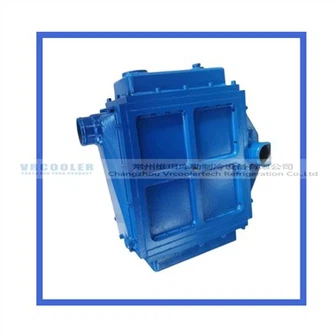
Water-cooled condensers usually have a larger shell with a large number of cooling water tubes inside. The cooling water tubes are usually made of copper alloy or stainless steel to ensure good thermal conductivity and corrosion resistance. Tube plates are used to secure the cooling water tubes and separate the shell side from the tube side. In order to enhance the condensation effect of steam on the shell side, some condensate collection devices and air extraction devices are also installed. For example, in some large condensers, the cooling water tubes may be arranged in a "U" or "snake" configuration to increase the flow of cooling water through the tubes and improve the cooling effect.
Advantages:
The cooling efficiency of water-cooled condenser is relatively high. Because water has a large specific heat capacity and can absorb a large amount of heat, it is possible to condense the turbine exhaust steam at a lower back pressure. Generally speaking, water-cooled condenser can keep the turbine exhaust pressure around 3 - 10kPa, which can improve the efficiency of the turbine and increase the power generation capacity. Meanwhile, the structure of water-cooled condenser is relatively compact and occupies less space than air-cooled condenser with the same cooling capacity.
Disadvantage:
It requires a large amount of cooling water, which requires a stable and reliable water source. If the quality of the cooling water is poor, it is easy to scale or cause corrosion in the cooling water pipe, thus affecting the performance of the condenser. For example, calcium, magnesium and other ions in the water will form scale on the high temperature cooling water tube wall, which will reduce the thermal conductivity of the cooling water tubes and increase the thermal resistance, leading to a decrease in the vacuum of the condenser and lowering the efficiency of the turbine. Moreover, the cooling water system of water-cooled condenser requires supporting cooling equipment, such as cooling tower, which increases the complexity and cost of the equipment.
Application Scenario:
Water-cooled condensers are mainly applied to thermal power plants and nuclear power plants in areas with abundant water resources such as near rivers, lakes and seas. For example, in large-scale thermal power plants in coastal areas, seawater is utilized as cooling water, and the condensation of turbine exhaust steam is achieved through water-cooled condensers to ensure the efficient operation of the turbine.

Air-cooled condenser
Working principle:
The exhaust steam from the turbine enters the tube bundle of the air-cooled condenser, and the heat exchange area is enlarged through the finned tube and other structures. Cold air flows outside the tube bundle and exchanges heat with the steam inside the tubes to cool and condense the steam. For example, in some northern thermal power plants, the air temperature is low, and the natural convection of cold air or under the forced action of the fan takes away the heat of the steam, so that the steam condenses into water.
Structural characteristics:
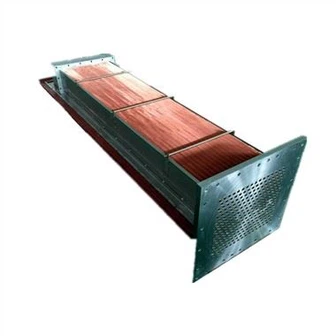
The air-cooled condenser is mainly composed of tube bundle, fan, support structure and other parts. The tube bundle generally adopts aluminum finned tubes to increase the heat dissipation area. The fan is used to provide forced ventilation so that the cold air flows through the tube bundle quickly. The support structure should ensure the stability of the whole air-cooled condenser in the outdoor environment. Moreover, the tube bundle arrangement of the air-cooled condenser is usually in "A" or "V" shape, which can increase the contact area and contact time between the air and the tube bundle and improve the cooling effect.
Advantages:
Its biggest advantage is that it does not need a large amount of cooling water, which is suitable for areas where water resources are scarce. At the same time, the operation of the air-cooled condenser is not affected by the water quality of the water source, and there is no problem of scaling and corrosion. In addition, in cold areas, the temperature of the cold air is lower, which can provide a better cooling effect and help reduce the exhaust back pressure of the turbine.
Disadvantages:
The cooling efficiency of air-cooled condenser is relatively low compared to water-cooled condenser. Due to the small specific heat capacity of air, in order to achieve the same cooling effect, a larger heat transfer area and more fans are required to provide sufficient air flow. This results in a bulky air-cooled condenser with a large footprint. Moreover, the performance of air-cooled condenser is greatly affected by environmental factors, for example, in hot weather or high air humidity, the cooling effect will be significantly reduced.
Application Scenario:
Air-cooled condensers are mainly used in thermal power plants and nuclear power plants in water-scarce areas.
Due to the scarcity of water resources, some thermal power plants use air-cooled condensers to condense turbine exhaust steam to ensure the normal operation of the units. At the same time, in some areas with high requirements for water protection, the use of air-cooled condenser is also prioritized.