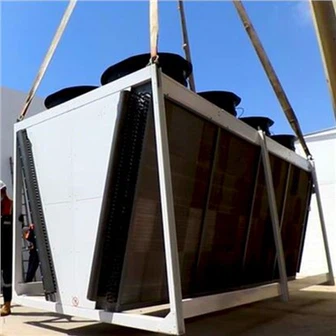
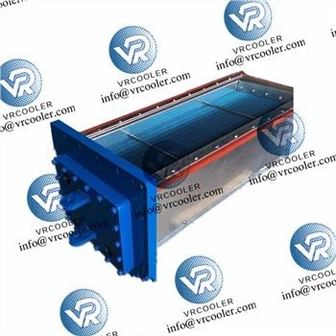
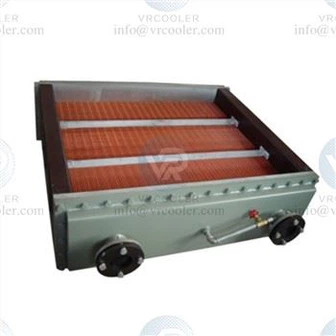
Air-Cooled Gas Aftercooler For Discharge Of Centrifugal Compressor
For industrial gas compression stations, chemical process plants, refineries, air separation units (ASU), and CO₂ carbon capture facilities, VRCOOLER engineers and manufactures custom heavy-duty Air-Cooled Gas Aftercoolers for Centrifugal Compressor Discharge. Operating at the high-pressure, high-velocity discharge of single- or multi-stage centrifugal compressors, VRCOOLER air-cooled aftercoolers reduce hot discharge gases from 120°C−220°C down to 35°C−45°C prior to downstream transmission, molecular sieve dehydration, or process injection. Built in full compliance with API 661 (ISO 13706) and ASME Section VIII Div 1 (with 'U' Stamp), our coolers incorporate low-pressure-drop multi-pass aerodynamic headers, anti-vibration tube bundle supports designed to eliminate impeller blade-pass acoustic resonance, and heavy-gauge finned tubes in Carbon Steel, 304L/316L Stainless Steel, 2205 Duplex, and Monel. Featuring intelligent VFD/EC forced or induced draft fan arrays, VRCOOLER aftercoolers deliver maximum polytropic compressor efficiency and zero unexpected downtime.

Operating Challenges at Centrifugal Compressor Discharge
Centrifugal compressors deliver continuous, high-mass-flow gas streams under demanding aerodynamic and thermal conditions. The discharge aftercooler must endure severe operating stresses:
Core Engineering Challenges:
High Discharge Temperatures (120°C−220°C): Isentropic compression generates significant heat that must be continuously dissipated to prevent thermal degradation of downstream piping, valves, and gas treatment media.
Strict Pressure Drop (ΔP) Limits: Excessive pressure drop across the aftercooler directly reduces the net mass flow, lowers compressor polytropic efficiency, and increases driver power consumption (kW/HP).
Acoustic & Mechanical Gas Pulsation: High-velocity discharge flows generate vortex shedding and blade-pass excitation frequencies that can induce destructive tube vibration and mechanical fatigue in standard radiator cores.
Moisture & Hydrocarbon Condensation: As the gas cools below its water or hydrocarbon dew point, aerosol droplets and liquid slugs form, requiring corrosion-resistant metallurgy, sloped drainage passes, and integrated liquid knockout separators.
Sour & Corrosive Gas Chemistry (H2S, CO2, Wet Chlorides): Untreated natural gas, biogas, or wet acid gases induce sulfide stress cracking (SSC) and chloride pitting corrosion under elevated temperatures and pressures.
VRCOOLER Engineering Innovations for Centrifugal Gas Aftercooling
At VRCOOLER, our heat transfer engineers utilize proprietary thermal-hydraulic modeling and finite element analysis (FEA) to engineer aftercoolers tailored for centrifugal compressor dynamics:
1. Ultra-Low Pressure Drop (ΔP≤0.3−0.5 bar) Nozzle & Header Design
Aerodynamic Transition Headers: Precision CNC-machined plug headers and rounded bonnet manifolds streamline high-velocity gas entry, eliminating localized eddy turbulence and recirculation zones.
Optimized Tube Pass Configurations: CFD-balanced multi-pass layouts minimize internal friction while maintaining high heat transfer coefficients (UU-values).
2. Anti-Vibration & Resonance-Decoupled Bundle Architecture
Reinforced Tube Support Baffles: Heavy-gauge support plates with radiused tube holes prevent fretting wear and eliminate acoustic lock-in with compressor blade-pass frequencies.
Floating & Expansion-Accommodating Tube Bundles: Proprietary bundle slide guides absorb severe axial thermal expansion without imposing mechanical stress on tubesheets or structural steel.
3. High-Integrity Tube-to-Tubesheet Joints
Precision Hydraulic Expansion with Grooved Tubesheets: Seamless tubes are hydraulically expanded into double-grooved tubesheet holes for leak-tight mechanical bonding.
Automated Orbital TIG Seal & Strength Welding: Critical process gas and sour service coolers feature full-strength seal welds tested with 100% Helium Mass Spectrometry to guarantee zero gas fugitive emissions.
4. Advanced Bimetallic & High-Efficiency Finned Tube Technology
Extruded Bimetallic Fins: Heavy aluminum outer tubes are extruded over high-pressure inner core tubes, creating a seamless, 100% metallurgical contact bond that resists atmospheric corrosion and cannot loosen under cyclic thermal shock.
Embedded 'G-Fin' & High-Temperature Finned Tubes: Grooved mechanical lock-in fins for continuous operating temperatures up to 350°C.
Protective Coatings: Blygold, PolyAl, phenolic, or electrofin coatings applied to aluminum fins for severe marine or coastal chemical plant installations.
Metallurgy Tailored to Process Gas & Ambient Conditions
VRCOOLER manufactures aftercooler bundles in strict adherence to NACE MR0175 / ISO 15156 for sour service and corrosive process streams:
ASME SA106 Gr B / SA179 Seamless Carbon Steel: Cost-effective solution for dry natural gas, instrument air, nitrogen, and non-corrosive hydrocarbons.
Austenitic Stainless Steel 304L / 316L (UNS S30403 / S31603): High resistance to carbonic acid (CO2), condensate moisture, and aggressive coastal ambient air.
Duplex Stainless Steel 2205 (UNS S32205 / EN 1.4462): Double the tensile strength of standard stainless steels with exceptional resistance to stress corrosion cracking and pitting (PREN≥35) in high-pressure sour gas.
Super Duplex 2507 & Nickel Alloys (Monel 400 / Inconel 625): Specified for extreme offshore marine environments, high-pressure wet H2S gas injection, and aggressive chemical synthesis compressors.
Major Industrial Applications
VRCOOLER air-cooled centrifugal compressor aftercoolers operate across critical global infrastructure:
Natural Gas Transmission & Pipeline Boosting: Discharge cooling on multi-megawatt centrifugal booster compressors prior to long-distance pipeline transmission.
Refinery Hydrocracker & Catalytic Reforming: Heavy-duty process gas cooling for hydrogen-rich, hydrocarbon, and recycle gas compressors.
Air Separation Units (ASU) & Cryogenic Plants: Intermediate and final discharge cooling for high-volume centrifugal air and nitrogen compressors.
Carbon Capture, Utilization & Storage (CCUS): Dense-phase and supercritical CO2 compressor aftercooling with moisture dropout protection.
Petrochemical Synthesis Units: Ethylene, propylene, and syngas compression trains requiring continuous, zero-leak process integrity.
Why EPCs & Compressor Package Builders Choose VRCOOLER
Global compressor packagers, EPC contractors, and refinery plant managers rely on VRCOOLER for high-integrity heat transfer:
Maximized Compressor Isentropic Efficiency: Precision aerodynamic header sizing keeps gas pressure loss (ΔP) to the absolute minimum, directly saving electrical driver power.
1:1 Dimensional Replacement Bundles: Custom-engineered replacement tube bundles designed to fit existing air cooler structural bays, piping flanges, and motor mounts without plant modifications.
Full Thermal & Mechanical Guarantee: Backed by ASME 'U' Stamp certification, comprehensive thermal simulation sheets, and complete NDT inspection dossiers.
Complete Modular Skidded Solutions: Available as standalone cooler bays or fully pre-piped modular skids featuring automatic louvers for winter anti-freeze control, liquid knockout separators, and integrated PLC control cabinets.
Frequently Asked Questions (FAQ)
Q1: Why is controlling pressure drop (ΔP) critical for centrifugal compressor aftercoolers?
A: Unlike positive displacement compressors, centrifugal compressors are highly sensitive to downstream backpressure. Every additional 0.1 bar of pressure drop across the aftercooler forces the compressor to operate against higher discharge head, increasing driver energy consumption and shifting the operating point closer to aerodynamic surge. VRCOOLER designs custom aerodynamic headers and generous tube cross-sections to keep ΔP strictly within design limits.
Q2: How does VRCOOLER prevent tube vibration caused by high-velocity gas discharge?
A: High-speed centrifugal compressor discharge flows can create acoustic standing waves and vortex shedding that resonate with cooler tubes. VRCOOLER conducts acoustic resonance and flow-induced vibration analyses per TEMA / API 661, incorporating optimized baffle spacing, anti-vibration detuning bars, and reinforced tube support grids.
Q3: What is the advantage of extruded bimetallic finned tubes for compressor aftercoolers?
A: Extruded bimetallic finned tubes feature a continuous aluminum sleeve extruded over the inner liner tube. This forms a solid mechanical bond that prevents atmospheric moisture from entering the fin-tube interface, eliminates galvanic corrosion, and maintains 100% thermal contact efficiency over decades of thermal cycling.
Q4: What process information is required to size a custom centrifugal compressor aftercooler?
A: Please provide the gas composition and molecular weight, gas mass flow rate (kg/h or Nm3/h), compressor discharge pressure and temperature, target cooler outlet temperature, allowable pressure drop (ΔP), and design ambient summer/winter temperatures.
Request an Air-Cooled Gas Aftercooler Engineering Proposal
Protect your centrifugal compression trains, lower parasitic operating power, and achieve uncompromised thermal reliability with VRCOOLER.
Explore VRCOOLER Compressor Heat Transfer Solutions: Visit www.vrcooler.com
Submit Your Technical RFQ: Contact our process engineering group directly at [email protected] with your compressor datasheets and project specifications.