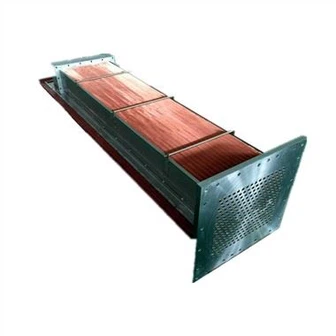
Advantages Of Dual Tube Air Cooler
1, Significant improvement in heat transfer efficiency and superior heat transfer performance
The core advantage of dual tube air coolers lies in their structural design that enhances heat transfer. The equipment adopts a double tube structure with nested inner and outer tubes, forming independent inner and outer channels. The two media flow in opposite directions inside and between the tubes, maximizing the heat transfer path and contact time. This counter current heat transfer mode keeps the temperature difference between the cold and hot media in the optimal range, and compared to single tube co current heat transfer, the heat transfer coefficient can be increased by more than 30%. At the same time, the inner surface of the double tube structure is usually designed with threads, fins, and other enhanced heat transfer elements, while the outer tube is equipped with high-efficiency heat dissipation fins to further expand the heat transfer area, enhance the turbulence of the fluid inside the tube, break the heat transfer dead zone that is prone to occur in the single tube structure, and make the heat transfer process more complete and uniform. Under the same heat exchange requirements, the equipment volume of dual tube air coolers can be reduced by 20% -40%, effectively reducing the footprint and installation cost, especially suitable for industrial scenarios with limited space.

2, Strong operational stability, outstanding resistance to pollution blockage and corrosion
The medium in industrial production often contains impurities, particulate matter, or is corrosive, which poses a serious challenge to the long-term stable operation of air coolers. The dual tube air cooler effectively solves this pain point through diversion design and structural optimization. The independent flow channel of the double tube makes the medium flow smoother, the velocity distribution is uniform, and reduces the probability of impurities depositing inside the tube; Even if some channels are slightly clogged, the other channel can still work normally without causing a significant decrease in the overall heat exchange efficiency of the equipment. During cleaning and maintenance, there is no need to stop the machine, only a single channel needs to be treated, ensuring the continuity of production. In addition, the dual tube structure can choose different materials for the inner and outer tubes according to the characteristics of the medium. For example, the inner tube is made of corrosion-resistant alloy material to resist strong acid and alkali medium erosion, while the outer tube is made of high-strength carbon steel to ensure structural stability. This differentiated material combination not only reduces equipment manufacturing costs, but also significantly improves corrosion resistance, extends equipment service life, and reduces operation and maintenance frequency and costs.
3, Wide adaptability to working conditions, significant energy-saving and consumption reducing effects
The structural flexibility of dual tube air coolers enables them to adapt to various complex industrial conditions, whether it is high temperature, high pressure, high flow heat exchange requirements, or dynamic operating scenarios with low load and variable working conditions, they can demonstrate excellent adaptability. In working conditions such as tower top condensation in the petrochemical industry and steam turbine exhaust cooling in the power industry, dual tube air coolers can achieve precise control of heat transfer efficiency by adjusting the medium flow rate and velocity of the inner and outer tubes, meeting the parameter requirements of different process stages; In cold regions or high dust environments in the north, the anti freezing and anti blocking design of the double tube structure can effectively avoid equipment downtime caused by environmental factors. Meanwhile, compared to traditional water coolers, dual tube air coolers do not require a large amount of water resources and only use air as a cooling medium, which can save more than 90% of industrial water and significantly reduce water consumption and treatment costs for enterprises; Its efficient heat transfer performance can also reduce the energy consumption of auxiliary equipment such as fans and pumps. The overall operating energy consumption is reduced by 15% -25% compared to single tube air coolers, which is in line with the current trend of green and low-carbon development in the industrial field.