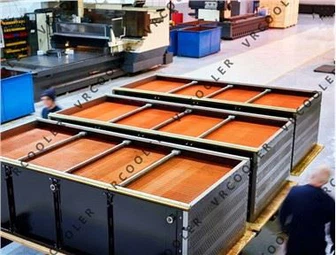
660MW Generator Hydrogen Cooler For Efficient And Stable Cooling
The reason why 660MW generators choose hydrogen as the cooling medium and pair it with a dedicated hydrogen cooler is mainly due to the unique physical characteristics of hydrogen and its high adaptability to the heat dissipation requirements of large units. Compared to traditional air cooling and water cooling solutions, the thermal conductivity of hydrogen is about 7 times that of air, and its density is only 1/14 of air. These two advantages make it an ideal choice for cooling large generators - high thermal conductivity can quickly remove the internal heat of the unit, greatly reducing the winding temperature; Low density can reduce the flow resistance during hydrogen circulation, lower the fan drive power, reduce the power consumption of the unit, and further improve power generation efficiency. The core function of the hydrogen cooler is to construct an efficient heat exchange channel, rapidly cool the hot hydrogen gas that has absorbed the heat of the unit, ensure the circulation and reuse of the cooling medium, and maintain the stable internal temperature of the unit within a safe range.
From the perspective of working principle, the generator hydrogen cooler and the unit cooling system work together to form a closed-loop system, which operates accurately and efficiently and can be divided into three core links. Firstly, during the operation of the generator, the single-stage plasma fans at both ends of the rotor pressurize the hydrogen gas. The pressurized cold hydrogen gas flows through the stator core air duct and rotor winding ventilation holes, fully contacting the heating windings and cores, absorbing a large amount of heat generated, and converting it into hot hydrogen gas; Subsequently, the hot hydrogen gas is introduced into the hydrogen cooler arranged at the end of the generator or inside the machine base, and indirectly exchanges heat with the circulating water in the cooling water pipe - the circulating water flows inside the pipe, and the hot hydrogen gas brushes over outside the pipe, achieving heat transfer through the pipe wall, and the temperature of the hot hydrogen gas is quickly reduced to the set value; Finally, the cooled hydrogen gas re enters the interior of the generator and continues to participate in the heat dissipation cycle. At the same time, the system maintains the purity of hydrogen gas (usually controlled above 95%, preferably 98%) and stable pressure (0.3-0.5MPa) through a hydrogen replenishment device to ensure the continuous and reliable cooling effect. The entire process does not require interrupting the operation of the unit, achieving synchronous promotion of heat dissipation and power generation, ensuring continuous and stable output of the unit.
As a key supporting equipment for 660MW level large generators, hydrogen coolers not only need to meet the requirements of efficient heat exchange, but also adapt to the strict requirements of high load and long-term operation of the unit. Its structural design and technical performance directly determine the reliability of the cooling system and the operational safety of the unit. At present, hydrogen coolers used in 660MW generators mostly adopt a shell and tube structure, which has a large heat exchange area, strong compressive performance, can adapt to high-pressure hydrogen environments, and is easy to install and maintain. The heat exchange tubes inside the cooler have undergone special anti-corrosion treatment, which can effectively resist the corrosion of circulating water and extend the service life of the equipment; In addition, the cooler is equipped with a comprehensive monitoring device, which is linked to the overall monitoring system of the unit to monitor key parameters such as hydrogen temperature and circulating water temperature before and after cooling in real time. Once a temperature abnormality occurs, an alarm can be triggered in a timely manner and linked for adjustment to prevent the risk of equipment overheating.
Compared to other cooling methods, the cooling system equipped with hydrogen coolers brings multiple significant advantages to 660MW generators and is more suitable for the operational needs of large units. Firstly, the heat dissipation efficiency is significantly improved. Hydrogen cooling can reduce the temperature of the generator winding by 30-50 ℃, effectively delaying the aging of insulation materials, extending the service life of the generator, and reducing the occurrence of faults and shutdowns caused by high temperatures, thus improving the availability of the unit; Secondly, the energy consumption loss is significantly reduced, the hydrogen flow resistance is small, and the fan drive power is low, which can reduce the power consumption rate of the unit and further improve the power generation economy, in line with the industry development trend of energy conservation and consumption reduction; Thirdly, it has higher operational safety. Hydrogen has stable chemical properties, does not support combustion (it needs to be mixed with air to 4% -75% to ignite), and does not corrode metal parts. Combined with the oil film seal formed by the sealing oil system, it can effectively prevent hydrogen leakage and air entry. In addition, with complete purity and pressure monitoring devices, it can effectively avoid safety risks; Fourthly, it is suitable for high load operation and can meet the heat dissipation needs of 660MW level units operating at full load for a long time. At the same time, it can cooperate with power grid peak and frequency regulation to ensure stable heat dissipation of the units under different working conditions.

In practical applications, the stable operation of the 660MW generator hydrogen cooler is directly related to the power generation efficiency and power supply safety of the entire power station. Whether it is the hydro generator unit of a hydropower station or the steam turbine generator unit of a thermal power station, as long as a 660MW capacity design is adopted, the hydrogen cooler is an indispensable core supporting component. Taking hydropower stations as an example, hydro generators rely on water flow to drive rotation and generate electricity. If the heat generated during unit operation cannot be dissipated in a timely manner, it will affect the unit speed and power generation efficiency. However, hydrogen coolers can ensure stable operation of the unit at rated load through efficient heat exchange, fully leveraging the advantages of clean energy and base load power of hydropower stations, and providing stable power supply for the power grid. At the same time, with the transformation of the power industry towards large-scale, high-efficiency, and green, the application of 660MW level generators is becoming increasingly widespread, and the performance requirements for hydrogen coolers are constantly increasing. Efficient, energy-saving, long-lasting, and intelligent hydrogen coolers have become an important supporting direction for upgrading and iterating large-scale generator sets.
It is worth noting that the normal operation of hydrogen coolers relies on standardized operation and maintenance management. Due to its operation in a high-pressure hydrogen environment, it is necessary to regularly check the sealing of the cooler and the integrity of the heat exchange tubes, promptly clean the scaling and debris inside the heat exchange tubes, and ensure that the heat exchange efficiency is not affected; At the same time, it is necessary to strictly monitor the purity and pressure of hydrogen gas, regularly replenish high-purity hydrogen gas, and avoid a decrease in heat dissipation efficiency and an increase in energy consumption due to a decrease in purity; In addition, it is necessary to regularly check the water quality of the cooling circulating water to prevent excessive water quality from causing corrosion and blockage of the heat exchange tubes, which may affect the normal operation of the cooling system. Standardized operation and maintenance can not only extend the service life of hydrogen coolers, but also ensure that they are always in optimal operating condition, providing continuous support for the stable operation of 660MW generators.
With the adjustment of energy structure and the rapid development of the power industry, 660MW level generators, as the core equipment for large-scale electricity production, have become increasingly important in terms of operational stability and efficiency. The hydrogen cooler, with its efficient heat transfer performance, excellent energy-saving effect, and reliable safety performance, has become a key component supporting the stable operation of large generators. It not only solves the heat dissipation problem of large units, but also helps units improve power generation efficiency, reduce energy consumption, and meet the needs of the era of green power development. In the future, with the continuous upgrading of cooling technology, hydrogen coolers will further optimize structural design, improve heat transfer efficiency, and enhance intelligent monitoring functions, providing stronger support for the efficient, safe, and stable operation of 660MW level generators and even larger capacity generators, injecting new impetus into the high-quality development of China's energy industry.