Tube Bundles Heat Exchangers For Atlas Air Compressor
Tube Bundles Heat Exchangers for Atlas Air Compressor

Air compressor operation, air compression temperature can rise to 100-200 ℃ (depending on the compression ratio), need to be through the heat exchanger to cool down to 40 ℃ or less (to avoid subsequent equipment due to high-temperature damage, while reducing the impact of condensate on the system).
The core of the bundle heat exchanger is the heat exchange between the tube process and shell process:
tube process: high temperature medium (compressed air or lubricating oil) in the internal flow of the metal tube bundle;
shell process: cooling medium (such as water or cold air) in the shell space outside the tube bundle flow;
two kinds of media through the tube wall heat transfer, high temperature medium is cooled, the cooling medium to absorb the heat and then discharged to complete the cooling process.
Tube bundle heat exchanger structure should be adapted to the working conditions of the compressor (high pressure, continuous operation), mainly including:
Tube Bundle (Tube Bundle)
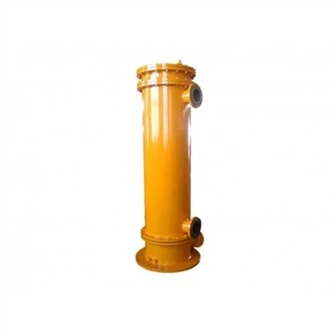
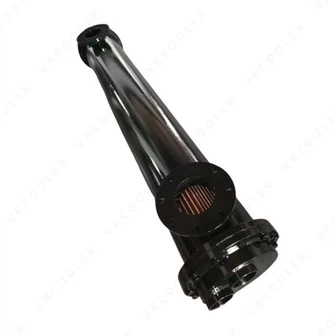
core heat transfer components, composed of multiple metal tubes (commonly used copper, copper alloy, stainless steel, etc., corrosion-resistant and good heat conduction), tube ends are fixed in the tube plate, part of the tube bundle will be designed to enhance the shell process medium turbulence, improve the heat transfer efficiency.
Shell (Shell)
surrounded by a tube bundle of closed container, usually cylindrical, with a head at both ends, used to guide the cooling medium flow and withstand the system pressure.
Tubesheets (Tubesheets)
located at both ends of the bundle of metal plates, used to fix the bundle of tubes and separate the tube course and shell course, to prevent the medium from mixing.
Inlet and outlet tubes
Includes tube inlet and outlet (connects to high temperature medium line of compressor) and shell inlet and outlet (connects to cooling water or air source).
Auxiliary parts
such as baffles (to enhance the shell medium disturbance), deflector (to optimize the medium flow), drain (discharge shell impurities or condensate) and so on.
Core Role in Air Compressor
Cooling Compressed Air
The compressed air can be cooled to reduce the load of subsequent drying equipment (such as suction dryer), improve the effect of water removal, and avoid the accumulation of condensate in the pipeline, which may lead to corrosion or equipment failure.
Cooling lubricating oil
For oil lubricated air compressor, the temperature of lubricating oil rises after cooling the piston, bearings and other parts, which needs to be cooled down by tube bundle heat exchanger to prevent the lubricating oil from deteriorating due to high temperature and prolong the service life.
Safeguard system safety
If the temperature of compressed air or lubricating oil is too high, it may lead to overloading of compressor motor, aging of seals and other problems, and the heat exchanger can control the temperature within the safe range.
Advantages
High-efficiency heat transfer: the tube bundle structure provides a large heat transfer area, together with the folding plate design to enhance the turbulence effect, the heat transfer efficiency can be up to 80%-90%;
Strong pressure resistance: the shell and tube bundles are made of high-strength metal materials, which can be adapted to the high-pressure working conditions of the compressor, and the operation is stable;
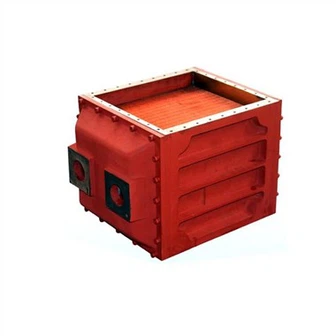
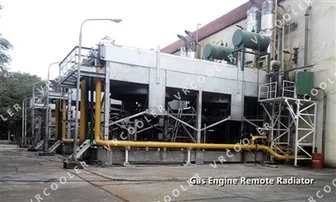
Adaptability: according to the type of cooling medium (water, air), the design of different structures (e.g., water-cooled tube bundle heat exchanger, air-cooled tube bundle heat exchanger), to adapt to different scenarios (water-cooled, air-cooled tube bundle heat exchanger). Wide adaptability: according to the type of cooling medium (water, air) can be designed with different structures (such as water-cooled tube bundle heat exchanger, air-cooled tube bundle heat exchanger) to adapt to different scenarios (such as water-cooled in areas of sufficient industrial water, air-cooled in areas of water shortage).
Applicable Scenarios
Reciprocating Air Compressor: commonly used to cool the high temperature compressed air and lubricating oil discharged from the cylinder;
Screw Air Compressor: mainly cools the oil-gas mixture, and the separated lubricating oil needs to be cooled individually;
Large Centrifugal Air Compressor: requires large-capacity tubular heat exchanger to cool the compressed air, and water-cooled is usually used to meet the demand for large heat exchange volume.