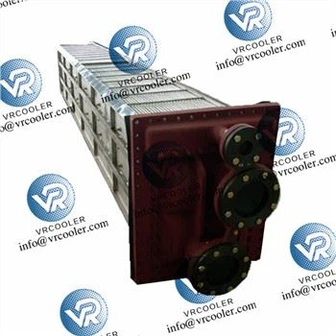
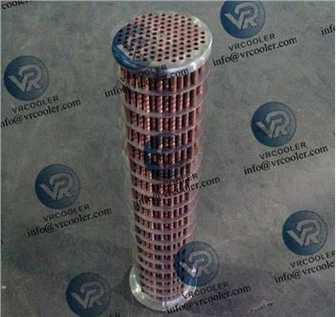
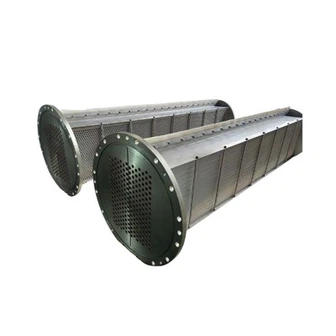
Tube Bundles For Water Cooling Condenser
Tube Bundles for Water Cooling Condenser
Heat transfer function: it is the key component of condenser to realize heat exchange, separating the cooling medium (water) inside the tube from the high temperature and high pressure gaseous refrigerant outside the tube through the wall of the tube bundle, and at the same time letting the heat be transferred from the refrigerant to the cooling water, so that the refrigerant can be condensed into liquid.
Increase the heat transfer area: the tube bundle consists of numerous tubes, which greatly increases the contact area between the cooling medium and the refrigerant, improves the heat transfer efficiency, and ensures that the refrigerant can be fully cooled and condensed.
Support and fixation: the tube bundle not only plays the role of heat transfer, but also plays the role of support and fixation for the whole condenser structure to ensure the stability and reliability of the condenser in the operation process.

Design Points
Tube Diameter and Tube Length: The selection of tube diameter and tube length should be determined according to the refrigeration capacity of the condenser, refrigerant flow rate, cooling water flow rate and other factors. Generally speaking, the larger the tube diameter is, the lower the cooling water flow rate is, but the lower the resistance loss is; the longer the tube length is, the larger the heat exchange area is, but the flow resistance will also increase.
Pipe spacing: pipe spacing affects the refrigerant and cooling water flow through the tube bundle when the flow state and heat transfer effect. Appropriate tube spacing can avoid mutual interference in fluid flow, improve heat transfer efficiency, while facilitating manufacturing and installation.
The number of tubes and the number of shells: the number of tubes refers to the number of times the cooling water flows through the tube bundle, the number of shells refers to the number of times the refrigerant flows in the shell. Increase the number of tubes and the number of shells can improve the heat transfer temperature difference, enhance the heat transfer effect, but will also increase the flow resistance and equipment complexity.