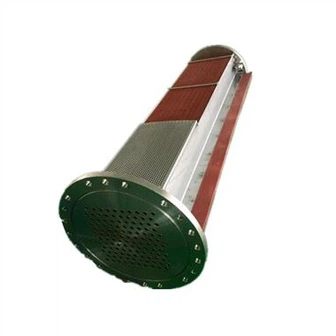
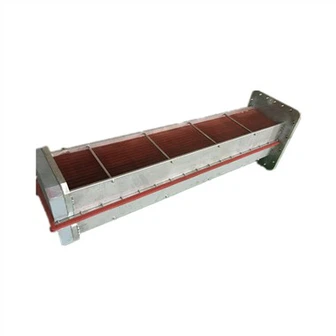
Transformer Oil Cooler For Wind Transformers
Transformer oil cooler applied to wind power transformer cooling
Transformer oil cooler is the core heat dissipation component of wind power transformer (especially double-fed, direct-drive and other mainstream models), and its performance has a direct impact on the operational stability, life span and power generation efficiency of wind power transformers. The special characteristics of wind power scenarios (e.g. high vibration, wide temperature range, high humidity / salt spray, difficult maintenance, etc.) put forward stringent requirements on the design, materials and reliability of the oil cooler.
The main sources of heat in wind power transformers are copper loss (winding resistance loss) and iron loss (core hysteresis / eddy current loss), and the oil temperature needs to be controlled at 60-95℃ during operation (the standard varies slightly for different insulation grades, e.g., the upper limit of Class A insulation is 105℃, and Class H can reach 180℃). Insufficient heat dissipation will lead to:
accelerated aging of the insulation material (for every 10℃ rise in temperature, the life span may be shortened by 50%);
increased winding resistance (copper resistance temperature coefficient of about 0.004/℃), further exacerbating losses, forming a vicious cycle of "overheating - increased losses - more heat";
extreme cases may trigger the protective devices In extreme cases, the protective device may be triggered to trip, leading to wind turbine shutdown, which directly affects the power generation.
Wind power scenario, forced air-cooled oil cooler ("air-cooled oil cooler") is the mainstream choice (accounting for more than 80%), some extreme environments (such as high-altitude, high-temperature areas) will use "air-cooled + auxiliary water-cooled" composite system. The core principle is: transformer oil in the pump drive, flow through the heat exchanger tube cooler, and tube outside the forced flow of air for heat exchange, the heat will be emitted to the environment.
1. Typical structure (forced air-cooled type as an example)
Core components: consisting of heat exchanger tube set (transformer oil passes inside), fins (intensified heat exchange on the air side), fan (forced air flow), tank / oil connection (connection to the transformer body), frame (support and protection).
Key differences from conventional industrial transformer coolers:
Vibration adaptability: tubes and fins are high-frequency welded or expanded + welded in a composite process to avoid loosening; frames with additional damping and vibration damping pads.
Anti-corrosion: Coastal / offshore models use 316L stainless steel (instead of 304) for the frame, heat exchanger tubes (mostly copper or copper alloy) surface passivation treatment or nickel-plated layer.