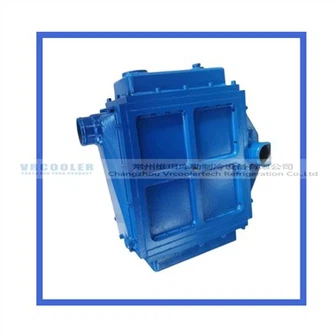
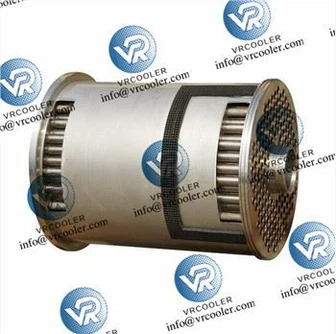
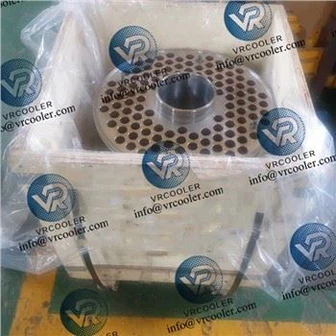
The Core Application Of Heat Recovery Heat Exchanger in ORC Power Generation System
The Organic Rankine Cycle (ORC) power generation system is a key technology for medium to low temperature waste heat recovery, and the heat recovery heat exchanger, as the core unit of energy conversion in the system, directly determines the efficiency of waste heat utilization and power generation stability. Its application value and technical points can be summarized as follows:

1, Core role
The heat recovery heat exchanger is the "energy bridge" between waste heat and organic working fluid in the ORC system: on the one hand, it absorbs low-grade energy such as industrial waste heat, solar energy, geothermal energy, etc., and transfers it to the organic working fluid; On the other hand, ensuring stable evaporation of the working fluid provides continuous power for the expansion machine to generate electricity, and its heat exchange efficiency directly affects the system's power generation efficiency by more than 30%.
2, Key technical requirements
1. Efficient heat transfer: using reinforced structures such as finned tubes and microchannels to maximize heat transfer within a limited volume;
2. Working fluid adaptation: Choose corrosion-resistant materials such as stainless steel and titanium alloy, and adapt to the characteristics of organic working fluids such as R245fa;
3. Adaptation to working conditions: able to withstand complex working conditions such as temperature fluctuations and dust, with anti scaling and easy maintenance design;
4. Compact and lightweight: Meet the spatial installation requirements of distributed power generation scenarios.
3, Typical application scenarios
Industrial waste heat recovery: adapted to process waste heat of around 200 ℃ in the steel and chemical industries, achieving waste heat power generation and carbon reduction;
• Renewable energy utilization: in conjunction with solar thermal and geothermal energy systems, stable conversion of low-grade thermal energy;
Distributed energy: Small heat exchangers are adapted to remote microgrids, utilizing biomass energy waste heat to achieve on-site power supply.
4, Development Trends
Developing towards enhanced heat transfer (microchannel, phase change heat transfer technology), material upgrades (high-temperature resistant alloys, anti-corrosion coatings), and intelligent monitoring (adaptive adjustment of operating conditions), further improving system integration efficiency and long-term reliability