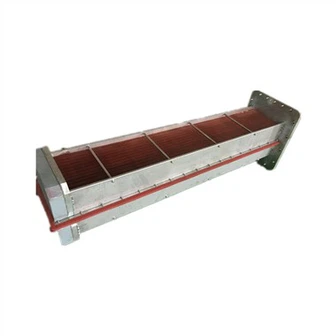
The Application Of Box Cooler in The Field Of Ships
Core working principle
Structure: Composed of U-shaped tube bundle (copper nickel alloy/stainless steel), tube plate, and seawater tank (with inlet and outlet grille), installed in the seawater tank below the minimum waterline on the outer side of the hull.
Process: High temperature fresh water (engine liner, lubricating oil, generator, etc.) inside the ship flows through the tube bundle; The seawater outside the ship flows outside the bundle and cools the fresh water through heat exchange; The cooled fresh water flows back to the equipment for circulation, and the seawater naturally rises and is discharged after absorbing heat.
Cooling mode:
During navigation, forced convection is generated as the ship moves, causing seawater to quickly wash over the tube bundle, resulting in the highest cooling efficiency.
Mooring/Anchoring Ground: Natural convection is formed inside the seawater tank (hot seawater rises and cold seawater sinks), and stable heat dissipation can still be achieved.
Main application scenarios
1. Power system cooling (core)
Host cooling: Cooling the cylinder liner water and exhaust system of the host to ensure stable operation of the host under all operating conditions.
Auxiliary engine/generator cooling: provides cooling for diesel generators and emergency generators to meet the power demand of the entire ship.
Gas turbine cooling: used for lubricating oil system and inter stage cooling of marine gas turbines, suitable for 5-50 MW units, can eliminate seawater pumps and save fuel.
Propulsion system: hydraulic and power units such as cooling thruster, bow thruster, and fully rotating rudder propeller.
2. Auxiliary system cooling
Hydraulic system: Cooling the hydraulic oil of deck machinery (such as cargo cranes, anchor cranes, winches) and servos to prevent leakage and failure caused by high oil temperature.
Air conditioning and refrigeration: providing a cold source for central air conditioning, refrigerated cabins, and food cold storage on ships, especially suitable for small and medium-sized vessels.
Central cooling system: As an alternative to central cooling, it integrates the cooling needs of the entire ship and reduces the need for seawater pipelines and pump units in the engine room.
3. Applicable ship types
Small and medium-sized vessels (mainly with a power of ≤ 5000 kW): tugboats, barges, fishing boats, ferries, engineering ships (dredgers), supply ships, refrigerated ships, icebreakers, coastal cargo ships/oil tankers, etc.
Special vessels: inland vessels, shallow draft vessels, offshore operation vessels, military vessels, platform supply vessels (PSV) and other ship types that require high reliability and space.

Key advantages (value in the field of ships)
Save cabin space: Cancel the seawater pump, filter, and a large number of seawater pipelines in the cabin, simplify the layout, and free up valuable cabin space.
Reduce corrosion risk: Seawater only flows inside the outboard box and does not enter the engine room pipelines and heat exchangers, greatly reducing internal corrosion and leakage hazards.
Low maintenance cost: no internal seawater cleaning or chemical dosing; Maintenance only requires visual inspection during dock repair, cleaning of the grille, and replacement of sacrificial anodes.
High reliability and redundancy: The structure is sturdy and not affected by pump failures; Multiple units can be connected in parallel to achieve redundant design, suitable for high reliability scenarios.
Energy saving and consumption reduction: Passive heat dissipation is the main approach to reduce the energy consumption of seawater pumps, directly lowering fuel consumption and emissions.
Adaptation to all operating conditions: Effective cooling can be achieved during both navigation and berthing, and stable heat dissipation can still be achieved through natural convection at low speeds and in stationary states.
Application limitations
Power upper limit: More suitable for small and medium-sized ships (usually ≤ 5000 kW), with less application for large ships (main engine power exceeding 30 MW).
Draft requirement: It needs to be installed below the lowest waterline, and shallow draft ships need to specially design the position of the seawater tank.
Sea condition impact: In extremely harsh sea conditions, the seawater tank grille may be blocked by debris and needs to be cleaned regularly.
Summary
Box Cooler is a lightweight and highly reliable upgrade solution for ship cooling systems, particularly suitable for small and medium-sized, inland/offshore, engineering, and special vessels. It has multiple values of space saving, anti-corrosion, low maintenance, and energy saving, with the core of outboard heat exchange, passive heat dissipation, and no engine room seawater pipeline. It is one of the preferred solutions to replace traditional central cooling systems in modern ship design.