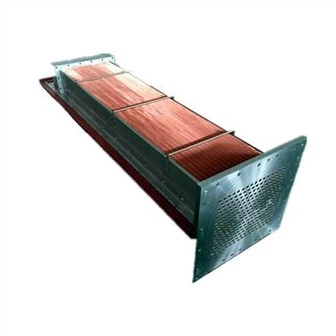
HVDC Converter Transformer Cooling Solutions | VRCOOLER
High-Voltage Direct Current (HVDC) and Ultra-High-Voltage (UHVDC, ±500 kV to ±1100 kV) converter transformers interface AC transmission grids with power electronic thyristor or IGBT converter valves. They operate under intense thermal and dielectric stresses unknown in conventional AC transformers-including massive high-frequency harmonic currents (up to the 50th harmonic), DC bias magnetic core saturation, combined AC-DC dielectric electric fields, and high stray flux heating in tank structures. VRCOOLER engineers heavy-duty Directed Forced-Air (ODAF) and Directed Water-Cooled (ODWF) thermal management systems with high-capacity oil pumps, harmonic-rated heat exchangers, and N+2 redundancy, ensuring 100% availability for long-distance bulk power transmission.

Why HVDC Converter Transformers Suffer Severe Thermal Overheating
In an HVDC converter station, the non-sinusoidal switching of converter valves generates severe electromagnetic phenomena that dramatically increase thermal losses:
Hvdc Converter Transformer Excess Thermal Losses
Key Focus Areas: High-Order • Dc Bias Flux & • Combined Ac-Dc
Key Focus Areas: Harmonic Currents • Core Saturation • Dielectric Stress
11th, 13th, - vs - DC neutral - vs - High voltage
23rd, 25th+ | currents shift | stress across
harmonics | magnetic B-H | oil-barrier
Skin effect & - vs - Massive stray - vs - insulation
eddy losses in - vs - leakage flux - vs - Requires ultra-
conductors | into tank walls | clean oil flow
Because total losses in an HVDC converter transformer are 20% to 40% higher than an equivalent MVA AC transformer, conventional natural cooling is inadequate. VRCOOLER designs high-velocity forced cooling loops to dissipate these concentrated thermal loads.
VRCOOLER HVDC Converter Transformer Cooling Configurations
Depending on converter station layout (indoor valve halls, outdoor converter yards, or offshore wind HVDC platforms), VRCOOLER manufactures specialized cooling systems:
|
HVDC Cooling Designation |
Primary Medium |
System Architecture |
Typical HVDC Application |
|---|---|---|---|
|
ODAF Air-Blast Coolers |
Ambient Air |
Independent skid-mounted cooler banks with N+2 fan redundancy |
Land-based ±500 kV/±800 kV±500 kV/±800 kV outdoor converter yards |
|
ODWF Water Heat Exchangers |
Deionized / Cooling Water |
Double-tube titanium or 316L shell-and-tube exchangers with leak sensors |
Offshore HVDC converter platforms, coastal converter stations |
|
Low-Noise Acoustic Coolers |
Forced Air |
Sound-attenuated cooler banks with low-speed sickle-blade fans (<55 dBA) |
Urban converter substations with strict acoustic boundary limits |
Engineering Innovations in VRCOOLER HVDC Cooling Systems
[HVDC Converter Transformer Tank] (High Harmonics + DC Bias Heat)
(Hot Insulating Fluid: 80°C - 90°C)
Submerged High-Head Glandless Oil Pumps
(Directs High-Velocity Fluid into VRCOOLER Heavy-Duty Matrix)
VRCOOLER Multi-Circuit ODAF / ODWF Heat Exchanger Skid
Redundant Fan / Water Channels (N+2 Operational Security)
Optimized Hydraulic Headers to Prevent Static Electrification
(Cooled Insulating Fluid: 45°C - 50°C)
Injected Directly into Valve Winding Insulation Barriers
1. Mitigation of Electrostatic Charging (Streaming Electrification)
In ultra-high-voltage HVDC transformers, high-velocity oil flow across cellulose insulation can generate dangerous static electrical charges (streaming electrification), triggering catastrophic internal discharges. VRCOOLER engineers oil manifolds with precision flow conditioning and controlled Reynolds numbers (Re<2,100Re<2,100), ensuring high convective heat transfer without generating hazardous electrostatic voltages.
2. High-Capacity Finned Tube Metallurgy
VRCOOLER** manufactures HVDC cooler bundles utilizing heavy-wall seamless copper or stainless steel tubes with extruded high-density aluminum fins. This robust construction absorbs thermal expansions caused by sudden HVDC power ramping (e.g., fast active power reversals).
3. Comprehensive N+2 Component Redundancy
Because an unplanned outage of an HVDC link can destabilize entire regional grids, VRCOOLER HVDC cooler skids feature full N+2 redundancy for both cooling fans and oil circulation pumps, supported by dual-redundant PLC automation and independent power supplies.
Technical Comparison: Standard AC Transformer vs. HVDC Converter Transformer Cooling
|
Parameter |
Standard 500 kV AC Transformer |
±800 kV±800 kV UHVDC Converter Transformer |
|---|---|---|
|
Thermal Loss Density (W/m3W/m3) |
Standard Baseline (1.0×1.0×) |
Elevated (1.35×1.35× to 1.50×1.50×) due to harmonics |
|
Harmonic Heating Factor |
Low (THD < 3%) |
High (THD 15% - 25% with 12-pulse converter valves) |
|
Cooler Operation Mode |
ONAN / ONAF |
Strictly Directed Forced (ODAF / ODWF) |
|
Cooler Redundancy Level |
N+1 Standard |
N+2 Redundant Pumps and Fan Groups |
|
Oil Flow Velocity Control |
Uncontrolled Thermosiphon |
Strictly Regulated to prevent Static Electrification |
|
Acoustic Noise Control |
Standard |
Heavy Acoustic Attenuation (Baffles + Silencers) |
Frequently Asked Questions (FAQ)
Q1: Why is acoustic noise higher in HVDC converter transformer coolers?
A: DC bias flux in the transformer core and high-frequency harmonic currents cause intense magnetostriction in the core steel, emitting high-frequency acoustic hum (100 Hz to 1,200 Hz). VRCOOLER incorporates vibration-isolating flexible bellows and sound-absorbing acoustic enclosures on all cooler headers and fan cowlings.
Q2: What cooling is used for offshore wind HVDC converter transformers?
A: Offshore converter platforms have severe weight and footprint limitations. VRCOOLER supplies ultra-compact ODWF titanium double-tube water-cooled heat exchangers that use seawater or closed-loop demineralized water, saving over 70% of the space required by air coolers.
Q3: How does VRCOOLER monitor thermal conditions in HVDC coolers?
A: Our HVDC skids feature multi-point Pt100 RTDs, differential pressure transducers, optical oil leak detectors, and digital flow meters connected via fiber-optic Modbus/IEC 61850 interfaces directly to the converter station SCADA.
Partner with VRCOOLER for Critical HVDC Thermal Engineering
Ultra-high-voltage power transmission demands zero-compromise thermal reliability. At VRCOOLER, our engineering team designs and manufactures world-class HVDC and UHVDC converter transformer cooling systems engineered to handle extreme harmonics, high DC voltages, and continuous gigawatt-scale power flows.
Explore VRCOOLER Ultra-High-Voltage Solutions: Visit www.vrcooler.com
Consult Our HVDC Engineering Specialists: Email [email protected] for technical specifications and project sizing.