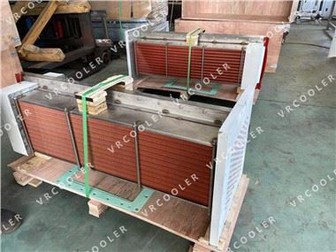
How To Design Air Compressor Cooler?
How to Design Air Compressor Cooler?
The design of an air compressor cooler involves a number of factors, including the type and power of the air compressor, operating conditions, ambient temperature and humidity, and so on.
The following are general steps and considerations for designing an air compressor cooler:
Determine Cooling Requirements: first, the heat generation rate of the air compressor needs to be determined. This can be calculated from the air compressor's power, run time, load, and efficiency. The design of the cooler needs to be able to handle this heat efficiently.
Selecting the cooling medium: Air compressor coolers typically use air or water as the cooling medium. Water coolers are usually more effective at high power and high-temperature conditions, while air coolers are suitable for low power and lower temperature conditions.
Calculating Cooling Capacity: Based on the heat generation rate and operating conditions of the air compressor, calculate the required cooling capacity.
This can be estimated by one of the following formulas:
- For air coolers: Q = m * C * ΔT
where Q is the cooling capacity (heat flow rate), m is the air mass flow rate, C is the specific heat capacity of the air, and ΔT is the temperature difference.
- For water coolers: Q = m * Cp * ΔT
where Q is the cooling capacity (heat flow rate), m is the water mass flow rate, Cp is the specific heat capacity of water, and ΔT is the temperature difference.
Type of cooler: Choose the right type of cooler, which can be a plate heat exchanger, a shell and tube heat exchanger, a heat sink or a dry cooler. The type of cooler depends on cooling requirements, space constraints and budget.

Cooler Layout: Design the physical layout of the cooler, including the size and shape of the radiators, the design of the passages and the location of the fans or pumps. Ensure that the cooler can adequately dissipate heat and receive good air or water flow.
Fan or water pump: If using an air cooler, choose a suitable fan to ensure adequate airflow. If using a water cooler, select a suitable water pump to ensure adequate water flow.
Control system: Add temperature and pressure sensors to monitor the performance of the cooling system. These sensors can be integrated with an automatic control system to ensure that the cooling system operates efficiently under a variety of load conditions.
Maintenance and Cleaning: Design the cooler for easy maintenance and cleaning. Regular cleaning and maintenance ensure the long-term reliability and performance of the cooler.
Regulatory compliance: Ensure that the design of the cooler complies with local environmental regulations and safety standards.
The final cooler design needs to take into account the above factors and may require engineering calculations and simulations to ensure that it meets the cooling needs of the air compressor. The best practice is to work with a specialist engineer, such as VRCOOLER, who can provide a customized cooler solution based on the specific application and requirements.