How Do Dry Coolers Differ From Cooling Towers in Gas Turbine Plants?
In gas turbine power plants, dry coolers and cooling towers serve the same fundamental purpose-rejecting waste heat-but they differ significantly in working principle, water usage, performance characteristics, and suitability for specific site conditions.
1. Working Principle
- Dry Coolers
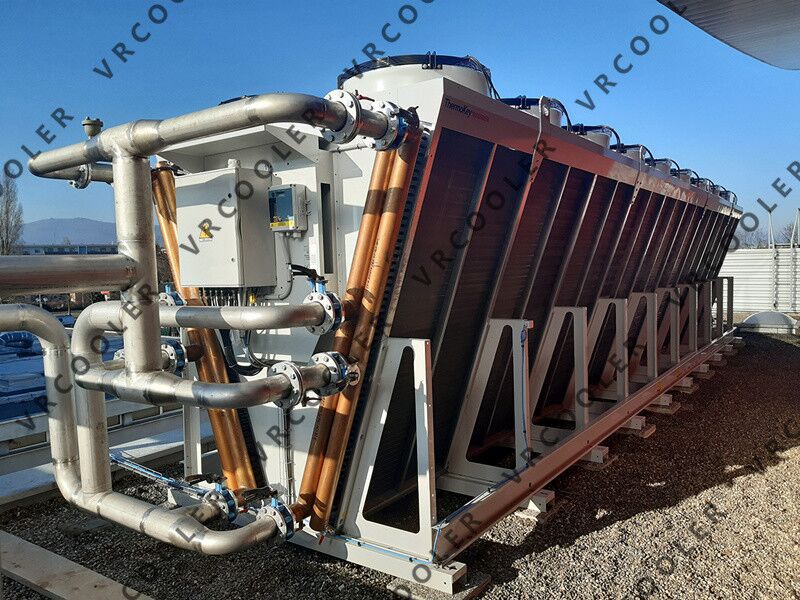
Dry coolers are air-cooled heat exchangers. Hot process water (or glycol mixture) from the gas turbine auxiliary systems-such as lube oil coolers, jacket water coolers, or closed-loop intercoolers-flows through finned tubes. Ambient air, driven by axial fans, removes heat via sensible heat transfer only. There is no evaporation.
- Cooling Towers
Cooling towers are evaporative cooling systems. Warm water is sprayed over fill material, and a portion of the water evaporates as air passes through the tower. The latent heat of evaporation removes heat, allowing the remaining water to cool to temperatures close to the ambient wet-bulb temperature.
2. Water Consumption
- Dry Coolers
Virtually zero water consumption
No make-up water required
No blowdown or drift losses
- Cooling Towers
High water consumption due to evaporation, drift, and blowdown
Requires continuous make-up water supply
Water chemistry management is critical
Implication for Gas Turbine Plants:
Dry coolers are preferred in water-scarce regions or where water permitting is difficult.
3. Cooling Performance and Temperature Limits
- Dry Coolers
Cooling approach is limited by ambient dry-bulb temperature
Cannot cool water below ambient air temperature
Performance drops significantly during hot summer conditions
- Cooling Towers
Can cool water close to wet-bulb temperature, which is typically much lower than dry-bulb temperature
Provide lower and more stable cooling water temperatures
Implication:
Cooling towers deliver better thermal performance, which can directly improve gas turbine output and combined-cycle efficiency.
4. Impact on Gas Turbine Efficiency
- Dry Coolers
Higher cooling water temperatures may increase:
Condenser pressure (in combined-cycle plants)
Auxiliary system temperatures
Can slightly reduce turbine efficiency during peak ambient temperatures
- Cooling Towers
Lower cooling water temperatures improve:
Steam cycle condenser vacuum
Overall combined-cycle efficiency
Better suited for large base-load power plants
5. Environmental and Regulatory Considerations
- Dry Coolers
No visible plume
No chemical water treatment
Lower environmental permitting complexity
Minimal risk of Legionella
- Cooling Towers
Visible water vapor plume
Requires biocides and scale inhibitors
Potential Legionella risk if not properly maintained
Stricter environmental and health regulations
6. Maintenance and Operational Complexity
- Dry Coolers
Simple mechanical systems
Maintenance mainly involves:
Fan motors
Fin cleaning
Lower O&M costs over plant life
- Cooling Towers
More complex systems
Regular maintenance required for:
Water treatment
Fill material
Drift eliminators
Basin cleaning
Higher long-term O&M costs
7. Capital Cost and Footprint
- Dry Coolers
Higher heat transfer surface area required
Larger footprint and higher fan power
Higher initial capital cost per MW rejected
- Cooling Towers
Generally lower capital cost for large heat duties
More compact for the same heat rejection capacity
8. Typical Applications in Gas Turbine Plants
- Dry Coolers Are Preferred When:
Water availability is limited or costly
Environmental regulations are strict
Plant is peaking or mid-merit operation
Simple, low-maintenance systems are desired
- Cooling Towers Are Preferred When:
Water is readily available
Maximum thermal efficiency is required
Plant operates as base-load
Combined-cycle performance is critical
Summary Comparison Table
| Aspect | Dry Cooler | Cooling Tower |
|---|---|---|
| Heat Rejection Method | Sensible (air-cooled) | Evaporative |
| Water Consumption | None | High |
| Cooling Limit | Dry-bulb temperature | Wet-bulb temperature |
| Efficiency Impact | Moderate in hot climates | High efficiency |
| Maintenance | Low | High |
| Environmental Risk | Very low | Moderate |
| Best Use Case | Water-scarce regions | Large base-load plants |
Conclusion
In gas turbine plants, the choice between dry coolers and cooling towers is driven by a balance between water availability, efficiency targets, environmental constraints, and lifecycle costs. Dry coolers offer a sustainable, low-maintenance solution where water is limited, while cooling towers remain the preferred option for achieving maximum thermal efficiency in water-abundant locations.