Generator Air Cooler For Hydro Generation And Pump Storage Plants
Generator Air Cooler For Hydro Generation and Pump Storage Plants
Hydroelectric generators (including "power generation / pumping bi-directional units" in pumped storage power stations) generate two main types of heat during operation, even in the case of synchronous generators with high efficiency:
Electromagnetic loss heat: copper loss of stator winding, rotor winding (generated by current flowing through the conductor), iron loss of the iron core (hysteresis / eddy current loss due to alternating magnetic field);
Mechanical loss heat: heat generated by bearing friction, rotor ventilation resistance and so on.
If this heat is not discharged in a timely manner, it will lead to an increase in the air temperature inside the generator (up to 80-100°C), which in turn will cause:
Winding insulation (such as epoxy resin, mica tape) accelerated aging, life shortening;
conductor resistance increases with temperature, additional increase in copper loss, the formation of a "thermal vicious circle";
iron core magnetic permeability decreases, the generator efficiency is reduced.

The core role of the generator air cooler is to forcibly cool the circulating air inside the generator to ensure that its temperature rise is controlled within the specified range.
Hydroelectric power station generator air cooler more indirect heat exchange structure, "air side" and "cooling medium side" of the two-way flow to realize the heat transfer, the specific process is as follows:
Air-side circulation:
generator built-in axial fan (or centrifugal fan) will generator internal hot air (temperature of about 50-80 ℃) forced blowing to the air cooler "air channel" (usually for the gap between the fin tubes);
heat exchange process:
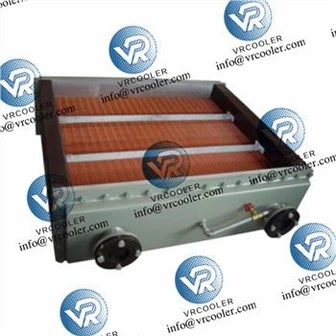
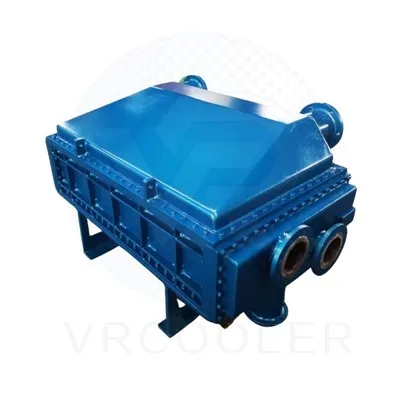
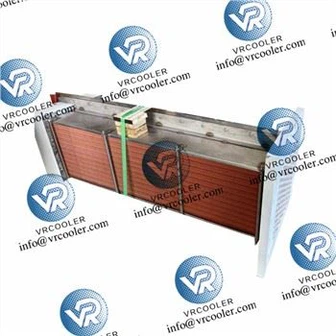
hot air flow through the air cooler finned tube bundles, the heat through the "air→fin→cooling medium". When hot air flows through the finned tube bundle of the air cooler, the heat is transferred to the cooling medium flowing inside the tube through the convection and conduction effect of "air → fin → tube";
Cooling medium side circulation:
The cooling water from the circulating water system of the power station (e.g., water from the reservoir, cooling tower circulating water, with a temperature of about 15-35 ℃) is introduced into the tube, and after absorbing the heat transferred by the tube bundle, the temperature rises by 5-10 ℃, and then returns to the circulating water system for cooling (or directly to the circulating water system for cooling). After absorbing the heat transferred by the tube bundle, the temperature rises by 5-10℃, and then returns to the circulating water system for cooling (or directly discharged into the reservoir, depending on the design of the power station);
Cold air reflux:
Cold air that has completed the heat exchange (the temperature is lowered to 30-45℃) re-enters into the internal generator and cools down the stator, rotor and iron core, forming the closed-loop circulation of "hot air discharging→cooling→cold air reflux".