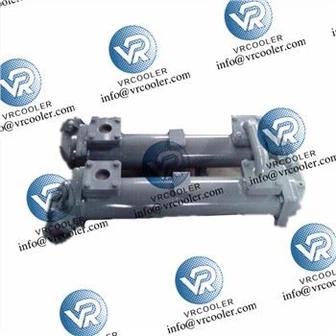
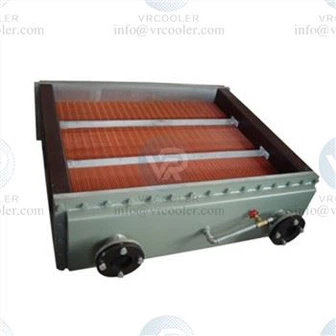
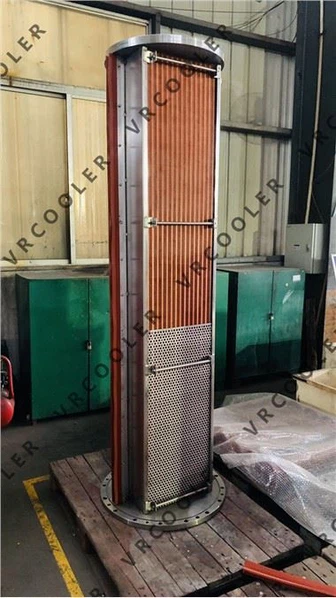
Double Tube Air Cooler: An Efficient Cooling Tool For Industrial Cooling
1, Core Definition and Structure
Its core feature is the use of a double-layer tube in tube structure:
Inner tube: It carries process fluids that require cooling, such as high-temperature gases, oil, refrigerants, etc.
Outer tube: It runs through a cooling medium (usually water, ethylene glycol solution, or other cooling liquids).
Air side: Forced air is blown through the outer wall of the double-layer casing by a fan to further enhance heat dissipation.
2, Working principle
The process fluid flows in the inner tube, and heat is transferred to the cooling liquid in the outer tube through the tube wall.
After absorbing heat, the coolant transfers the heat to the flowing air through the pipe wall.
The air is driven by a fan, taking away heat and achieving dual cooling (liquid cooling+air cooling), ultimately achieving the goal of efficient cooling.

3, Main uses and advantages
Efficient heat transfer: The double-layer structure increases the heat transfer area, and combined with liquid cooling and air cooling, the cooling efficiency is much higher than that of ordinary single tube air coolers.
Precise temperature control: The outlet temperature can be flexibly controlled by adjusting the coolant flow rate or air flow rate, suitable for processes with strict temperature requirements.
Corrosion resistance and safety:
The inner tube can be made of corrosion-resistant materials such as stainless steel and titanium, while the outer tube protects the inner tube and extends its lifespan.
If the inner tube leaks, the outer tube can act as a seal to prevent the process fluid from directly mixing with air/coolant, improving safety (especially suitable for toxic and flammable fluids).
Application Scenario:
Chemical/Petroleum: Cooling high-temperature process gases, lubricating oils, hydraulic oils.
Refrigeration/air conditioning: used as a condenser or evaporator in precision refrigeration systems.
Electricity/Energy: Air/gas cooling for generator sets and fuel cells.
Industrial manufacturing: cooling systems for air compressors, injection molding machines, and laser equipment.