CACA Coolers For High-Power Motors in Cement Plants
In a cement plant, people usually pay attention to the kiln, the mill, or the fan that suddenly goes quiet. They do not spend much time thinking about the motor cooler until dust starts building up, temperatures start climbing, and a production line that is supposed to run continuously begins to feel fragile. That is exactly why CACA coolers matter. On large cement drives, especially the motors behind kiln fans, raw mills, clinker cooler exhaust fans, and other heavy-duty equipment, the cooling arrangement is not a minor accessory. It is part of the motor's survival strategy. ABB's cement application literature describes kilns as requiring reliable, high-performance motors for continuous operation in varying conditions, and it lists major cement duties such as ID/FD fans, baghouse fans, preheater tower fans, kiln gas fans, clinker cooler exhaust fans, and raw mills among the applications where robust motor-and-drive packages are essential.

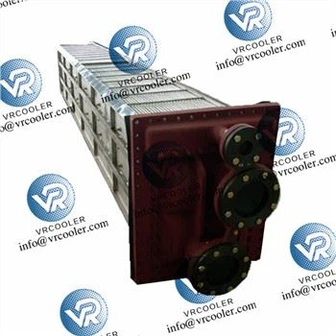
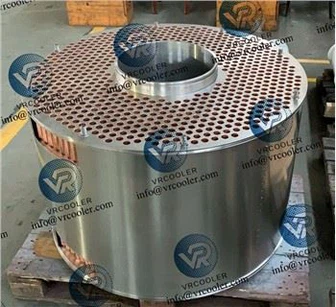
A CACA cooler is essentially a closed air circuit, air-cooled system, commonly associated with IC611 motor cooling. In this arrangement, the motor's internal air stays in a closed loop, while ambient air passes separately through the cooler to remove heat. ABB describes IC611 as a fully enclosed motor design with an air-to-air heat exchanger, while Sterling Thermal Technology explains the working principle in plain language: ambient air moves through the tube bores, and the clean internal machine air passes over the outside of those tubes, so the motor's primary cooling air is kept separate from the outside environment. That separation is the real value. In a cement plant, where fine dust never seems to disappear, keeping abrasive dirt and moisture out of the motor internals is a practical advantage, not just a catalog feature.
That is why CACA coolers make so much sense on high-power motors in cement plants. Cement production is hard on rotating equipment. ABB's cement references repeatedly describe the sector as a place of demanding conditions, strict application requirements, and continuous-process duty. The same material also notes that cement dust greatly increases wear in less suitable motor arrangements and explicitly says that a totally enclosed AC motor frame is much more suited to the cement environment. In other words, when a plant is moving raw material, feeding a kiln, grinding clinker, or pulling gas through filters and preheater systems, the motor needs protection not only from load and heat, but also from the plant atmosphere itself. A CACA-cooled motor helps by isolating the internal cooling air from that dusty external world.
In practice, you will most often see this kind of cooling considered for the larger, more valuable motor positions in the plant. Cement lines rely heavily on fans and mills, and those are exactly the duties where motor reliability quickly becomes a plant-wide issue. ABB notes that clinker cooler exhaust fans play a critical role in the process because they help control kiln hood pressure and overall thermal balance, while mills are process-critical and have a major impact on throughput and operating cost. When motors in those services are large, medium-voltage or high-voltage, and expected to run for long hours with limited interruption, engineers tend to prefer cooling arrangements that are enclosed, predictable, and easier to protect from contamination. That is the environment where CACA coolers earn their reputation.
From a technical standpoint, CACA cooling is also a good fit for the size range of motors often found around major cement equipment. ABB's high-voltage engineered motor catalog covers customized motors from the hundreds of kilowatts into the multi-megawatt class, with complete ranges extending up to 23,000 kW, and it shows IC611 / IP55 as a standard combination for certain modular motor configurations. The same catalog states standard design conditions such as Class F insulation, maximum temperature rise of 80°C by resistance, 40°C ambient, and 1000 m altitude or less as the baseline for the published data. That does not mean every cement motor should be specified the same way, but it does show that CACA-type cooling belongs firmly in the world of serious industrial motors rather than light-duty auxiliary equipment.
There is also a maintenance argument for CACA coolers, and it is a practical one. A closed-air motor is not maintenance-free, but it is often easier to protect and manage than an arrangement that continually pulls contaminated plant air through the motor itself. WEG's motor maintenance guidance for IC611 air-air heat exchanger motors says the cooling pipes and any noise attenuator must be kept clean and unobstructed to maintain proper heat exchange, and it recommends brushing out accumulated dirt and cleaning attenuators with dry compressed air when needed. That is the kind of maintenance cement operators understand well: regular cleaning, inspection, and temperature awareness, rather than waiting for dust contamination to shorten winding life or upset bearing temperatures.
What this means in real plant terms is simple. If a cement producer is investing in a high-power motor for a raw mill, separator, preheater fan, kiln gas fan, or clinker cooler exhaust fan, the motor cooler should be chosen with the same seriousness as the bearings, insulation system, and drive interface. A CACA cooler is attractive because it combines the protection of a totally enclosed machine with the heat rejection capacity needed for larger motors. It helps the motor stay cleaner inside, supports stable temperature control, and fits the reality of a plant where dust, long operating hours, and process continuity are all part of daily life. In a cement factory, that is often the difference between a motor that merely runs and a motor that keeps running when the rest of the process cannot afford to stop.