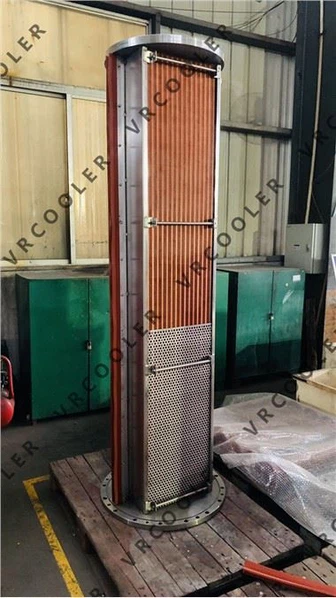
Application Practice Of Transformer Oil Cooler in Substation
1, The role and importance of transformer oil cooler
The main function of transformer oil cooler is to efficiently transfer the heat in transformer oil to the external environment, keeping the oil temperature within the allowable range. Its role is mainly reflected in the following aspects:
1. Control oil temperature to ensure insulation life
Transformer oil is both a cooling medium and an insulating medium. Excessive oil temperature can accelerate oil aging, reduce breakdown voltage, and shorten equipment lifespan. The cooler can effectively control the top oil temperature to not exceed 85 ℃ (for conventional oil immersed transformers).
2. Enhance the load capacity of transformers
Good heat dissipation capability can increase the allowable load rate of transformers, enabling equipment to operate safely during peak load periods.
3. Ensure continuous power supply to the substation
Cooler failure is often one of the important reasons for transformer shutdown. A stable and reliable cooling system can significantly improve the reliability of power supply in substations.
4. Adapt to different environmental conditions
Reasonable selection of cooler types can ensure the operational performance of transformers in environments with high temperature, high humidity, high altitude, or high dust levels.

2, Types of transformer oil coolers commonly used in substations
According to the different cooling media and circulation methods, the common oil coolers in substations mainly include the following types:
1. Air cooled oil cooler (AF/AN)
Natural air cooling (AN): relying on natural convection of air for heat dissipation, with a simple structure, no noise, and no need for power supply, suitable for small capacity transformers.
Forced air cooling (AF): equipped with a fan, high heat dissipation efficiency, suitable for medium and large transformers.
Advantages: easy maintenance, low cost, high reliability.
Disadvantages: The heat dissipation ability is greatly affected by the ambient temperature.
2. Water cooled oil cooler (WF)
Using water as the cooling medium, it has high heat dissipation efficiency and is suitable for large capacity and high loss transformers.
Advantages: Stable cooling effect, not affected by environmental temperature.
Disadvantages: Requires a cooling water system, poses a risk of water leakage, and maintenance is relatively complex.
3. Forced oil circulation air cooling (OFAF)
The hot oil is forcibly transported to the cooler through an oil pump, and then cooled by a fan.
Strong heat dissipation capability, suitable for large power transformers.
Advantages: High heat dissipation efficiency and fast response speed.
Disadvantages: Requires oil pump and fan, high energy consumption.
4. Forced oil circulation water cooling (OFWF)
Combined with forced circulation of oil pump and efficient heat exchange of water cooler, suitable for ultra large transformers or special environments.
Advantages: The strongest heat dissipation capability, suitable for high load and high ambient temperature scenarios.
Disadvantages: The system is complex and requires high water quality.
To ensure the long-term stable operation of the cooler, the substation needs to do the following maintenance work:
1. Regularly clean the heat sink
Dust and oil stains can reduce heat dissipation efficiency, and should be cleaned at least once a year.
2. Check the operation status of the fan and oil pump
Including current, vibration, noise, bearing temperature, etc., any abnormalities should be promptly replaced.
3. Check the oil flow indicator
Ensure normal oil flow and avoid cooling failure caused by blockage or oil pump failure.
4. Check the electrical control circuit
Including temperature controllers, contactors, cables, etc., to ensure reliable automatic switching function.
5. Regularly inspect the quality of insulation oil
Including dielectric loss, breakdown voltage, moisture content, etc., to ensure good cooling and insulation performance.
6. Winter antifreeze measures
Insulation and heat tracing should be done well for the water cooling system to prevent freezing.
Transformer oil cooler is a key equipment in substations to ensure the safe operation of main transformers. Whether the selection is reasonable and the operation is stable directly affects the load capacity, insulation life, and power supply reliability of the transformer. By selecting appropriate cooling methods, optimizing configuration quantities, and strengthening operation and maintenance, the overall operational level of the substation can be significantly improved. With the development of smart grids, oil coolers will also move towards intelligence, efficiency, and low energy consumption, providing more reliable guarantees for the safe and stable operation of substations.