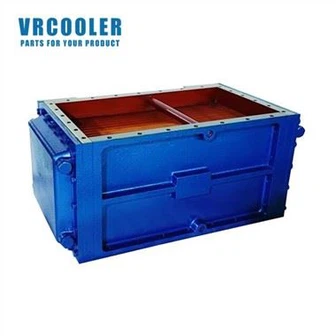
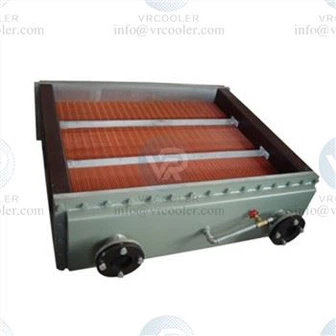
Marine Air Coolers for Mitsubishi Diesel Engines
In marine engineering, thermal management is not just about efficiency-it is about survival in one of the harshest operating environments. For turbocharged Mitsubishi diesel engines, marine air coolers (commonly referred to as boost air coolers or charge air coolers) are essential components that ensure stable performance, fuel efficiency, and long service life.

What Is a Marine Air Cooler?
A marine air cooler is a heat exchanger installed between the turbocharger and the engine intake manifold. Its primary function is to reduce the temperature of compressed air before it enters the combustion chamber.
During turbocharging, air temperature can rise significantly due to compression. Without cooling, this hot air has lower density, which reduces oxygen availability for combustion. A marine air cooler solves this by lowering the air temperature, increasing density, and enabling more efficient combustion.
Why Mitsubishi Diesel Engines Require High-Performance Air Coolers
Mitsubishi diesel engines are widely used in marine propulsion and auxiliary power systems due to their robustness and high output. However, marine conditions introduce several challenges:
High ambient humidity
Salt-laden air leading to corrosion
Continuous high-load operation
Limited ventilation in engine rooms
Marine air coolers are specifically engineered to address these challenges, ensuring that engines maintain optimal intake air conditions regardless of external factors.
Types of Marine Air Coolers
Air-to-Water Air Coolers
This is the most common configuration in marine applications.
Uses seawater or freshwater as the cooling medium
Compact design suitable for engine room installation
High heat transfer efficiency
These systems are ideal for large Mitsubishi engines used in cargo ships, offshore platforms, and tankers.
Air-to-Air Air Coolers
Less common in marine environments but used in smaller vessels or where water systems are limited.
Simpler structure
Lower maintenance requirements
Dependent on ambient air conditions
Key Design Features
Marine air coolers for Mitsubishi engines are not standard heat exchangers-they are engineered for durability and performance:
- Corrosion-resistant materials: Copper-nickel alloys, stainless steel, or coated aluminum
- High-pressure tolerance: Designed to handle turbocharged air pressures
- Compact footprint: Optimized for confined marine engine rooms
- Vibration resistance: Reinforced structures for continuous engine operation
- Easy maintenance: Removable tube bundles or accessible cleaning ports
Application Fields in Marine Industry
Main Propulsion Systems
Marine air coolers are used in large Mitsubishi engines that drive ship propulsion systems. They ensure consistent power delivery during long voyages and varying load conditions.
Auxiliary Generator Sets
Ships rely on auxiliary engines for onboard electricity. Air coolers help maintain stable generator performance, especially during peak electrical demand.
Offshore Platforms
In offshore oil and gas installations, Mitsubishi diesel engines power pumps, compressors, and emergency systems. Air coolers are critical for continuous, reliable operation in corrosive offshore environments.
Fishing and Work Vessels
Smaller vessels also benefit from air coolers, particularly when engines operate for extended periods under variable loads.
Performance Benefits
Installing a high-quality marine air cooler provides several operational advantages:
- Improved combustion efficiency: Cooler, denser air enhances fuel burning
- Higher engine output: Increased oxygen availability boosts power
- Reduced exhaust gas temperature (EGT): Protects downstream components
- Extended engine lifespan: Lower thermal stress on internal parts
- Better fuel economy: Optimized air-fuel ratio reduces consumption
Maintenance Considerations
To ensure long-term performance, marine air coolers require routine maintenance:
Regular cleaning to remove salt deposits and fouling
Inspection for corrosion or leakage
Monitoring of cooling water quality
Periodic pressure testing
Proper maintenance not only extends the life of the cooler but also prevents engine performance degradation.
Conclusion
Marine air coolers are a critical component in Mitsubishi diesel engine systems, directly influencing performance, reliability, and efficiency. In demanding marine environments, where engines must operate continuously under harsh conditions, these heat exchangers provide the thermal control necessary to keep operations running smoothly.
For shipbuilders, operators, and maintenance teams, selecting a well-designed marine air cooler is a strategic decision-one that impacts not only engine performance but also overall vessel reliability and operating costs.